

The transportation sector is undergoing a massive shift toward electrification. Electric vehicle adoption has doubled since 2020. This surge creates a pressing need for robust charging infrastructure, especially at major hubs like airports and within large fleet operations.
Today’s travelers and businesses prioritize sustainability. Over 40% of customers now factor eco-friendly options into their decisions. This trend makes accessible power for electric vehicles a critical service. Fixed charging stations have limitations in dynamic environments.
Mobile charging solutions offer the necessary flexibility. They deliver power directly to ground support equipment, rental cars, and passenger vehicles. This approach reduces installation costs and timelines for infrastructure upgrades. It adapts to the unique demands of large-scale operations.
For airports and commercial fleet managers, this mobile charging integration is essential for maintaining efficiency. It ensures vehicles remain available with minimal downtime. We at BeeCharge EV specialize in these tailored solutions. Our services provide on-demand power that meets your specific logistical needs.
This guide explores practical approaches for implementing mobile power systems. We cover technology options, best practices, and financial considerations to position your operations for success in the electric era.
Key Takeaways
- The rapid growth of electric vehicles demands immediate action from transportation hubs and large fleets.
- Mobile charging provides unmatched flexibility compared to fixed station installations.
- Successful implementation requires a clear understanding of daily operational rhythms and peak demand periods.
- This adaptable technology supports a wide range of equipment, from baggage tugs to passenger shuttles.
- Proper planning minimizes vehicle downtime and maximizes availability.
- Tailored solutions address the unique challenges of large-scale, dynamic environments.
- Expert partners can streamline the integration process and ensure long-term operational efficiency.
Introduction to Mobile Charging for Airports and Fleets
Electric mobility is no longer a future concept but a present-day reality across the United States. The rapid adoption of electric vehicles has created immediate infrastructure needs that traditional solutions struggle to address.
Overview of EV Adoption in the U.S.
Since 2020, sales of electric vehicles have tripled, with projections showing 27 million on American roads by 2030. Over 4% of new cars sold are now electric, up from just 1.5% in 2020. This growth creates significant demand for accessible power solutions.
The average EV range now exceeds 250 miles, reducing range anxiety but increasing the need for convenient charging options. Transportation hubs host nearly 15% of public charging infrastructure nationwide.
Importance of Seamless Charging Solutions
Seamless power delivery systems integrate into existing workflows without disruption. They address critical gaps in coverage during peak travel periods or at remote locations. This technology ensures vehicle availability meets operational demand.
Fleet professionals recognize that inadequate charging solutions cause downtime and schedule delays. Proper energy management directly impacts efficiency across the transportation industry.
We at BeeCharge EV offer membership programs with predictable pricing structures. Our services ensure reliable power access for drivers and operations teams. Explore elite benefits at https://www.beechargedev.com/beechargedev-membership-elite-access-to-premium-mobile-ev-charging-solutions/
Emergency roadside assistance becomes increasingly important as EV adoption grows. Our 24/7 services provide peace of mind at https://www.beechargedev.com/emergency-ev-roadside-assistance/
Strategic Integration of Mobile Charging for Airport and Fleet Operations
Forward-thinking transportation centers are embracing dynamic power distribution methods to overcome infrastructure limitations. This approach delivers energy where it’s needed most, adapting to real-time operational demands.
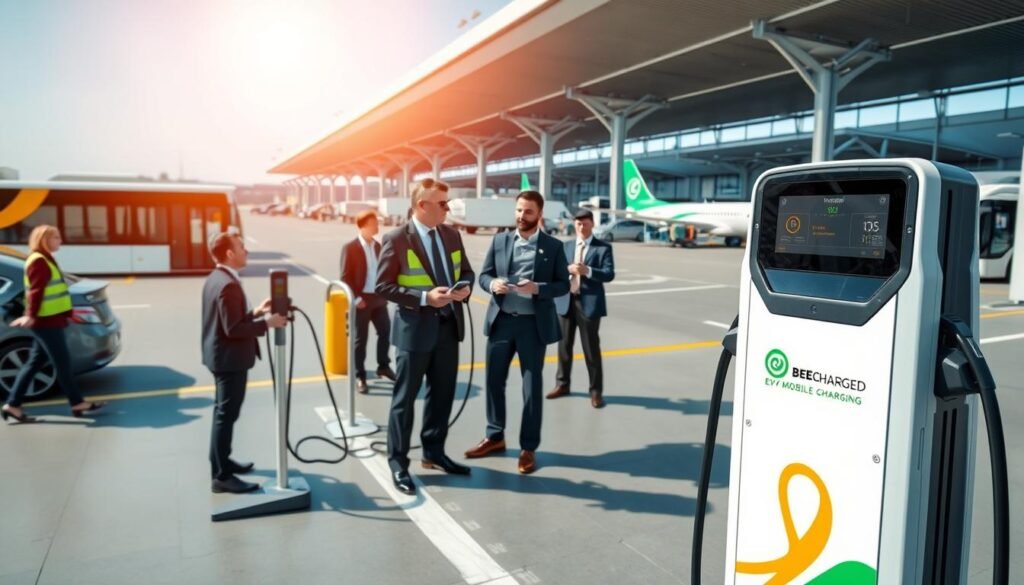
Successful implementation begins with comprehensive assessment of all electric vehicles within aviation facilities and commercial fleet operations. Cataloging equipment types, battery capacities, and daily usage patterns informs smart infrastructure planning.
Mobile charging units provide unmatched flexibility, moving between locations based on real-time demand. This reduces non-revenue travel time and ensures power availability matches operational rhythms across sprawling campuses.
Integration with existing management systems enables automated dispatch based on battery status and operational priorities. Dynamic load balancing prevents grid overloads while optimizing energy expenses.
We offer specialized fleet services designed for commercial operations, including scheduled visits and on-demand power delivery. Our mobile infrastructure solutions scale with growth, avoiding lengthy construction timelines.
Strategic coordination across all stakeholders creates seamless charging workflows that maximize efficiency and vehicle availability throughout transportation facilities.
Understanding Mobile Charging Solutions and Technologies
Understanding the diverse charging technology available is crucial for selecting the right mobile power solutions. These systems range from basic portable units to advanced fast-charging platforms.
Charging Station Types and Compatibility
Level 1 chargers use standard outlets but deliver limited range. They work for overnight needs but lack commercial speed. Level 2 charging stations provide faster power, adding significant range per hour.
DC Fast Charging represents the highest tier. This technology restores 100+ miles in minutes. Connector compatibility remains essential across all chargers.
Modern systems must accommodate multiple plug types. J1772, CCS, and NACS connectors serve different vehicle populations. Proper battery management ensures safe, efficient power delivery.
Wireless Power Transfer and Dynamic Charging Capabilities
Wireless charging technology uses inductive power transfer. It eliminates physical connections for consistent parking locations. This approach reduces wear on charging ports and cables.
Dynamic capabilities allow charging during brief stops. While still developing, this technology shows promise for shuttle routes. It extends operational range without dedicated charging stops.
We offer commercial Level 3 charging solutions for time-sensitive applications. Our mobile DC fast charging delivers rapid energy restoration nationwide. These systems protect your battery health while maximizing vehicle availability.
Benefits of Mobile Charging Integration
Mobile power solutions deliver measurable improvements in productivity and satisfaction metrics for organizations managing electric fleets. These systems provide immediate operational benefits that enhance overall facility performance.
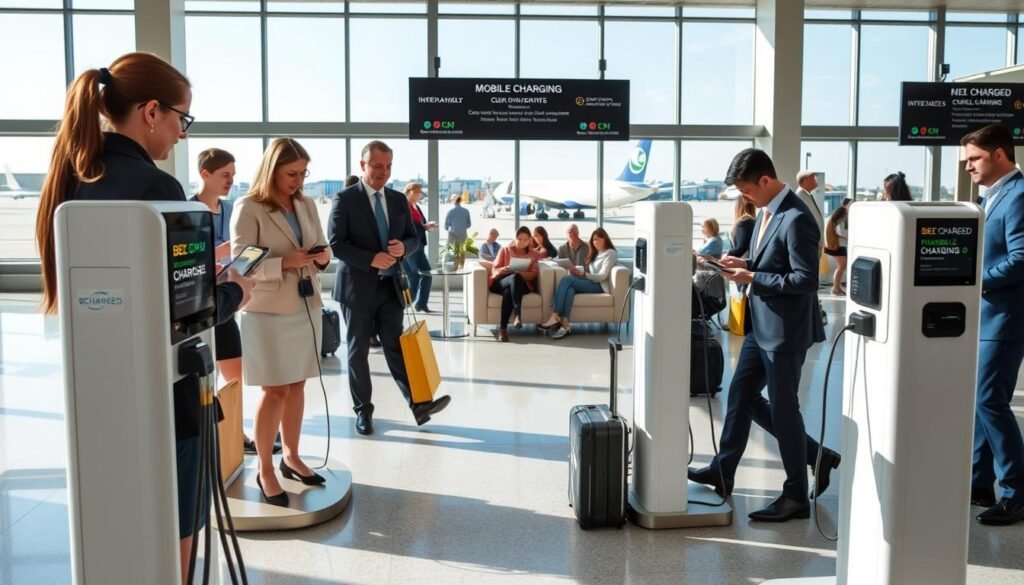
Reducing Downtime and Boosting Operational Efficiency
Portable charging units slash vehicles downtime by 40% compared to fixed infrastructure. This dramatic reduction allows assets to remain in service areas ready for deployment.
Operational efficiency improves through optimized power delivery schedules. Fleets spend more time on revenue-generating activities rather than traveling to remote charging facilities.
Fast charging capabilities reduce vehicle downtime by 65%. Staff can focus on other critical tasks while maintaining equipment readiness.
Enhancing Customer and Employee Experience
Customer satisfaction increases when range anxiety disappears through readily available charging options. Properties with dedicated EV power saw 19% higher repeat bookings.
Employee experience improves significantly with convenient charging access. Worker satisfaction ratings reach 4.3-4.6 stars in networks with high uptime.
Our comprehensive service ecosystem includes emergency towing for disabled electric vehicles. This ensures complete support for transportation operations.
Educational resources help professionals understand best practices for mobile power integration. Expert insights are available through our podcast series for continuous learning.
Infrastructure Requirements and Installation Guidelines
The backbone of any electric vehicle charging system lies in robust electrical infrastructure planning. Comprehensive assessments determine whether existing power service can support additional loads or requires utility upgrades.
Assessing Electrical Capacity and Make-Ready Infrastructure
Site evaluations begin with detailed electrical capacity analysis. This process identifies potential needs for transformer installations or service panel expansions. Proper assessment prevents grid overloads while supporting future growth.
Make-ready infrastructure involves installing conduits and wiring pathways for expansion. This forward-thinking approach allows organizations to add charging infrastructure incrementally. It avoids repeating expensive trenching work as electrification progresses.
Mobile solutions significantly reduce permanent installation requirements compared to fixed stations. Self-contained units eliminate extensive electrical construction in remote areas. This approach minimizes upfront costs and construction timelines.
Parking area design must accommodate charging equipment access and traffic flow. Clearly marked zones prevent non-EV parking while allowing efficient mobile unit navigation.
We offer mobile infrastructure solutions that deliver enterprise-grade capabilities without lengthy construction. Our approach provides rapid deployment while minimizing permanent power requirements. Explore flexible options at https://www.beechargedev.com/mobile-infacture/
Phased implementation strategies validate operational patterns before committing to permanent stations. This method ensures grid coordination aligns with actual usage demands and utility rate structures.
Real-World Case Studies and Success Examples
Documented success stories reveal how organizations are overcoming infrastructure challenges with innovative approaches. These case studies provide valuable insights for the entire transportation industry.
Airport Electrification Initiatives and Examples
Major transportation hubs demonstrate impressive results. The Port Authority Bus Terminal in New York implemented wireless charging stations for electric buses.
This reduced downtime significantly during passenger operations. Atlanta’s citywide electric bus network achieved similar success with integrated charging infrastructure.
Texas A&M University’s campus deployment shows how convenient access influences user behavior. Their wireless charging pads increased facility utilization by 12%.
Fleet Management Success Stories
Commercial fleet operations show remarkable improvements. Hertz’s rental electric vehicle expansion reduced customer complaints by 34%.
Their app-guided charging system eliminated confusion about station locations. Marriott properties with dedicated charging saw 19% higher repeat bookings.
Electrify America’s Phoenix network achieved 98% uptime through predictive maintenance. These examples prove that proper planning delivers reliable charge capabilities.
We help organizations implement similar strategies. Call 888-675-9555 to discuss transforming your operations with proven mobile solutions.
Overcoming Challenges and Adhering to Regulatory Standards
Compliance with established industry protocols ensures safe and efficient operation of electric vehicle power delivery systems. Navigating multiple layers of government oversight requires careful planning and expertise.
Navigating Zoning, Permits, and Installation Logistics
Zoning approvals and permit acquisition often involve lengthy coordination across jurisdictions. Municipalities like Miami and Denver frequently require retrofitting older structures to handle electrical loads.
Installation logistics present significant costs and management challenges. Coordinating utility upgrades during operational hours demands precise scheduling. Proper staff training ensures smooth system operations.
Complying with U.S. Government Regulations and Industry Standards
Federal regulations encompass multiple agencies with specific requirements. FAA guidelines protect aviation systems from interference. OSHA standards mandate workplace safety protocols.
Industry technical standards from SAE and IEEE define interoperability parameters. These regulations ensure equipment compatibility across manufacturers. Environmental compliance addresses sustainability reporting requirements.
Mobile solutions typically face fewer regulatory hurdles than permanent installations. This classification can accelerate deployment timelines while reducing costs.
We maintain expertise in complex regulatory environments for transportation applications. Call 888-675-9555 to discuss compliance considerations for your specific operational context.
Future Trends in Mobile Charging and EV Infrastructure
Next-generation charging technologies are transforming how organizations approach power delivery. The landscape is shifting toward intelligent systems that optimize energy usage and operational efficiency.
Projections indicate 300% growth in energy infrastructure by 2030. This expansion requires 1.2 million new public charging ports nationwide. Smart systems will play a crucial role in meeting this demand.
Advancements in Smart and Contactless Charging Solutions
Artificial intelligence now powers advanced charging management platforms. These systems analyze historical usage patterns to predict future needs. They automatically adjust schedules based on grid capacity and operational priorities.
Contactless technology continues evolving beyond current wireless systems. Research focuses on increased power transfer efficiency and dynamic capabilities. This innovation could eventually enable charging during vehicle movement.
| Current Technology | Future Innovation | Key Benefits |
|---|---|---|
| Basic power delivery | AI-optimized charging | Cost savings, grid stability |
| Physical connectors | Contactless systems | Reduced maintenance, convenience |
| Manual scheduling | Predictive analytics | Optimal vehicle deployment |
| Standard monitoring | Real-time diagnostics | Proactive maintenance alerts |
Scalability and Evolving Technological Needs
Vehicle-to-grid integration represents emerging capabilities. Electric vehicles can serve as distributed energy storage during peak demand. This creates potential revenue streams while supporting grid stability.
Battery technology improvements drive charging strategy evolution. Higher energy density allows faster power replenishment during operational breaks. Data analytics platforms provide sophisticated insights for continuous optimization.
We at BeeCharge EV continuously invest in emerging technologies. Our solutions incorporate the latest advancements in smart charging and energy management. Partner with a forward-thinking provider by calling 888-675-9555 to discuss tomorrow’s charging landscape today.
Conclusion
The strategic adoption of mobile power systems is now a critical success factor for modern transportation facilities. This approach delivers measurable benefits including 40% reduced downtime and 22% lower energy costs in documented implementations.
Successful integration requires comprehensive planning addressing technology selection and operational workflows. Mobile charging solutions provide distinct advantages over fixed infrastructure for dynamic environments.
Real-world case studies demonstrate improved customer satisfaction and enhanced operational efficiency. These achievements support corporate environmental commitments while meeting growing electric vehicles needs.
We stand ready to support your organization’s electrification journey. Our specialized services include fleet solutions, mobile infrastructure, and commercial Level 3 charging capabilities.
Contact BeeCharge EV today at 888-675-9555 or visit our website to discuss tailored solutions for your airport or commercial fleet operations. Let’s power your electric future with proven reliability and excellence.
FAQ
What are the primary benefits of integrating mobile charging for airport and fleet operations?
The primary benefits include significantly reducing vehicle downtime, boosting operational efficiency, and enhancing the experience for both customers and employees. Mobile power solutions provide flexibility to meet peak demand, support fleet management systems, and improve overall energy reliability without the need for permanent infrastructure changes.
How does mobile charging technology support existing fleet management systems?
Our mobile charging stations are designed for seamless integration with modern fleet management systems. They provide real-time data on charge status, energy use, and maintenance needs. This technology enables smart charging, which helps optimize costs, manage power consumption, and ensure vehicle range and reliability for daily operations.
What infrastructure is required to deploy mobile charging solutions at an airport or depot?
Deployment requires an assessment of existing electrical capacity and make-ready infrastructure. Key considerations include available power sources, parking layout, and grid connection points. Our team assists with the entire process, from initial site evaluation to installation, ensuring the system meets your specific energy demands and operational needs.
Can mobile chargers help manage peak energy demand for electric vehicle fleets?
Absolutely. Mobile charging units are an excellent tool for demand management. They can be deployed strategically to avoid overloading the local grid during peak usage times. This smart approach to energy distribution helps control costs and maintains the reliability of your charging infrastructure.
What future trends in EV charging should airports and fleets prepare for?
The industry is moving towards more advanced smart charging and contactless solutions. Future trends include increased scalability, higher charging rates, and greater integration with renewable energy sources. Investing in adaptable mobile charging technology now ensures your operations can easily evolve with these technological advancements.
How reliable are mobile charging stations compared to fixed installations?
Our mobile charging stations are engineered for high reliability and durability, matching the performance of many fixed installations. They offer the critical advantage of flexibility—being deployed where and when needed most. This mobility reduces the risk of operational downtime caused by a single point of failure in a fixed charging system.