

The transition to electric commercial vehicles presents unique challenges for transportation leaders. Many fleet operators struggle with infrastructure limitations that can delay electrification plans. Traditional fixed charging stations require significant investment and permanent space allocation.
This creates barriers for organizations operating in urban environments or remote locations. Fortunately, innovative solutions now exist to overcome these obstacles. Mobile power delivery systems bring flexibility to electric vehicle operations.
Our comprehensive guide explores the complete spectrum of power delivery methods available today. We examine both permanent installations and temporary solutions that adapt to changing operational needs. Fleet managers will discover practical approaches to assess their specific requirements.
Understanding power capacity needs and operational patterns is essential for successful implementation. The right infrastructure choice depends on budget, timeline, and daily vehicle usage patterns. Mobile technology eliminates geographical constraints, enabling electrification in challenging environments.
Whether beginning the transition or optimizing existing electric operations, this resource provides expert guidance. Real-world case studies and industry insights help managers make informed decisions that support sustainable transportation goals.
Key Takeaways
- Flexible power solutions address infrastructure limitations for commercial electric vehicles
- Mobile systems provide charging capabilities in locations without permanent installations
- Successful implementation requires careful assessment of operational patterns and power needs
- Different charging approaches suit various budget constraints and implementation timelines
- Geographical flexibility enables electrification in urban and remote operating environments
- Expert guidance helps fleet managers navigate the complex landscape of available options
- Practical strategies support both new electrification projects and existing electric fleet optimization
Introduction to Mobile Charging for Electric Fleets
America’s commercial vehicle sector is embracing electrification at an unprecedented pace, creating new infrastructure demands. This evolution transforms how transportation companies approach their daily operations.
The landscape for powering commercial EVs continues to expand rapidly. Major networks are deploying fast chargers to meet growing needs.
Overview of the EV Charging Landscape
Today’s charging infrastructure includes diverse approaches. Permanent depot installations serve as foundational elements. Public networks provide additional support for vehicles on routes.
Innovative mobile solutions address gaps in coverage. These flexible approaches complement traditional stations. They ensure reliable power access across different operational scenarios.
The industry faces significant demand for accessible charging. Many regions experience infrastructure limitations. This creates challenges for consistent fleet operations.
Context for Fleet Operators in the United States
U.S. fleet managers operate in varied environments. Urban delivery services often access established networks. Rural transit operations may face limited infrastructure options.
Understanding available power solutions is crucial for success. The right strategy depends on specific operational patterns. It also considers geographical constraints and budget parameters.
Mobile technology offers game-changing flexibility. It enables power delivery without permanent installation requirements. This approach supports electrification across diverse American landscapes.
What mobile charging options are available for electric buses and trucks, and how can fleet managers leverage them?
On-demand power solutions are transforming the landscape for commercial vehicle electrification across diverse operational environments. These portable systems bring unprecedented flexibility to fleet operations.
Defining mobile charging and its significance
Portable power delivery represents a fundamental shift in infrastructure strategy. Instead of requiring vehicles to travel to fixed locations, energy comes directly to them. This approach eliminates geographical constraints that often hinder electrification projects.
The significance extends beyond mere convenience. Roving charging enables operations in areas where permanent installations are economically challenging. It also supports temporary sites and emergency scenarios without long-term commitment.
Key considerations for fleet managers
Selecting the right portable solution requires careful assessment of operational patterns. Managers must evaluate daily mileage, route requirements, and available space for deployment. Battery capacity and power output vary significantly across different systems.
Providers like Bee Charged EV offer turnkey mobile infrastructure solutions that deploy rapidly. These systems bypass construction delays and permitting challenges. Understanding your specific power needs ensures optimal performance without operational disruptions.
Understanding Charging Infrastructure Solutions
Effective infrastructure deployment begins with evaluating central depot capabilities against route-based needs. This analysis determines the foundation of your power strategy. We see managers succeed by matching solutions to their specific operational patterns.
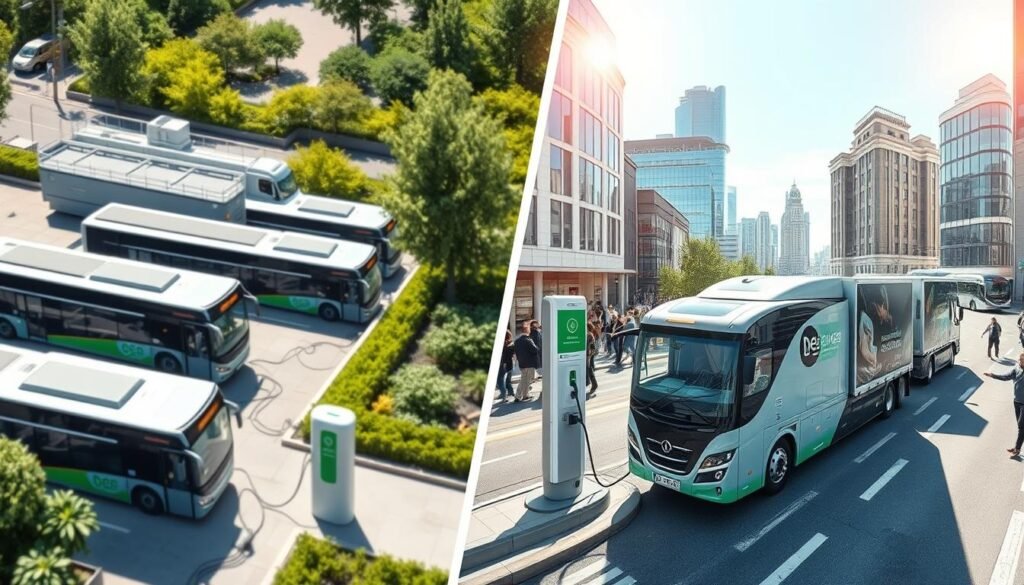
The core decision involves choosing between depot-based and on-route power delivery. Each approach offers distinct advantages for different fleet scenarios.
Depot charging vs. on-route charging
Depot systems provide power at a central facility. They are ideal for operations with predictable overnight downtime. School buses and many transit routes benefit from this controlled environment.
Permanent installations require adequate electrical capacity. Managers must assess if their facility is EV-ready. Significant construction and power upgrades may be necessary.
For Class 3 or larger vehicles, depot-based power is often the primary option. Industry data confirms 83% of these heavy-duty vehicles are well-suited for this method.
On-route solutions use public stations or opportunity charging. These systems top up vehicles during brief stops along their routes. This approach supports extended operational hours.
| Feature | Depot Charging | On-Route Charging |
|---|---|---|
| Primary Location | Central Fleet Facility | Public Stations & Route Stops |
| Ideal For | Overnight Charging, Scheduled Breaks | Opportunity Top-Ups, Extended Routes |
| Infrastructure Need | Potential Facility Upgrades & Construction | Reliance on Existing Public Networks |
| Control & Reliability | High | Variable (Depends on Station Availability) |
Integrating public and permanent installation options
The most robust strategies combine multiple approaches. Permanent depot charging serves as a reliable foundation. Public stations add flexibility for vehicles on extended duty.
Integration requires thorough route analysis. Identify stations with adequate power output and correct connectors. Also, confirm their availability during your operational windows.
This hybrid model addresses gaps in coverage. It is particularly valuable in areas with sparse public infrastructure. Combining systems ensures operational continuity and power security.
Advantages of Mobile and Temporary Charging Solutions
Temporary power solutions unlock new possibilities for fleet electrification in locations where permanent installations face obstacles. These adaptable approaches deliver energy directly to commercial vehicles regardless of geographical constraints.
We see managers benefit from unparalleled operational flexibility. Remote construction sites and seasonal operations gain reliable power access without infrastructure investments.
Accessibility and flexibility for off-grid operations
Portable systems eliminate barriers in regions with limited charging infrastructure. They support operations in challenging environments where fixed stations aren’t feasible.
Quick deployment capabilities make these units ideal for temporary needs. Fleet managers can respond to changing demands without long-term commitments.
Emergency, scheduled, and app-based charging services
Emergency support services provide critical assistance when vehicles face unexpected power shortages. Bee Charged EV’s emergency services typically cost $50-$150 per call, getting drivers back on route quickly.
Scheduled solutions operate through subscription models. Providers deliver battery storage systems to depots for predictable monthly fees.
App-based services revolutionize on-demand power delivery. Fleet managers request assistance through mobile applications that dispatch nearest available units.
For immediate emergency support, call 888-675-9555. Comprehensive fleet services integrate both scheduled and emergency options for complete operational coverage.
Implementing Fleet Charging Strategies
Strategic implementation of fleet charging infrastructure requires careful planning and assessment. We guide managers through evaluating their specific operational requirements and available resources.
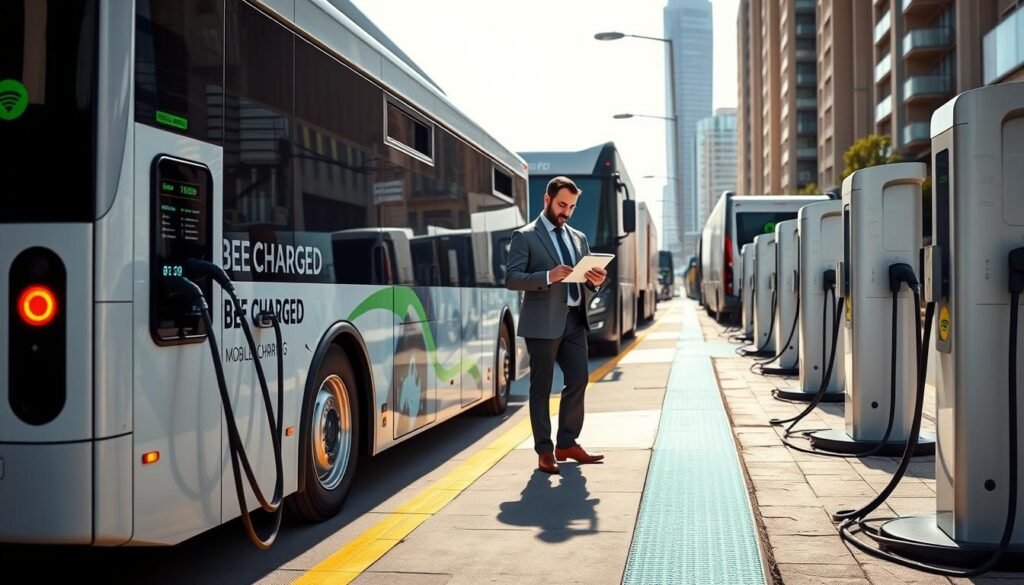
Successful deployment begins with understanding your facility’s electrical capacity. Managers must assess whether their depot is EV-ready or requires upgrades.
Assessing on-site power and operational needs
Thorough evaluation includes analyzing current power supply against future demands. Consider simultaneous charging requirements and peak power draw.
Operational analysis examines duty cycles, daily mileage, and route patterns. This determines the power levels needed to keep vehicles operational.
When existing infrastructure proves insufficient, battery-integrated solutions bridge the gap. These systems store energy during off-peak periods for efficient delivery.
| Assessment Area | Critical Considerations | Impact on Solution Selection |
|---|---|---|
| Electrical Infrastructure | Available capacity, upgrade requirements, utility rates | Determines feasibility of permanent installations |
| Operational Patterns | Daily mileage, dwell times, charging windows | Guides power level and speed requirements |
| Space Requirements | Deployment area, mobility needs, expansion plans | Affects solution scalability and flexibility |
| Timeline Constraints | Lead time, availability, implementation speed | Influences choice between temporary and permanent options |
Leveraging charge management systems and CaaS
Charging-as-a-Service models offer turnkey approaches to electrification. Providers handle installation, maintenance, and monitoring for predictable monthly fees.
These solutions can be operational within a week, bypassing lengthy construction timelines. Commercial Level 3 charging solutions deliver the high-power DC fast charging that heavy-duty vehicles require.
Charge management systems integrate with yard management to optimize vehicle assignments. They schedule charging during off-peak hours, reducing costs by 30-40%.
As fleets expand, solutions scale from mobile units to permanent installations. Bee Charged EV’s elite membership provides comprehensive support with priority service and dedicated account management.
Optimizing Fleet Operations with Mobile Charging Options
Successful implementation stories reveal how portable energy solutions overcome traditional infrastructure limitations. Industry leaders demonstrate practical approaches that enhance operational efficiency across diverse scenarios.
Case Study Examples and Best Practices
Transit agencies combine permanent depot installations with backup mobile charging units. This strategy ensures service reliability during peak demand or station malfunctions. Construction companies deploy Mobile Mounted chargers on skids at remote job sites.
These semi-permanent solutions move with projects without extensive electrical work. Urban delivery fleets use app-based services when vehicles exceed planned range. This maintains on-time performance without depot returns.
Best practices include detailed energy consumption tracking and route analysis. Diversified approaches yield optimal results: permanent stations for baseline needs, public networks for extensions, and portable options for flexibility. Charge management systems automatically balance loads and prioritize urgent vehicles.
Emergency preparedness is critical. We recommend maintaining relationships with providers like our towing support services. For ongoing insights, the Bee Charged EV podcast offers expert perspectives on evolving technologies.
Conclusion
Modern fleet electrification success hinges on the strategic integration of adaptable charging technologies. The landscape has evolved significantly, offering sophisticated solutions that meet diverse operational needs across the United States.
From semi-permanent skid-mounted units to emergency battery systems, managers now enjoy unprecedented flexibility. Understanding specific requirements—power availability, space constraints, and budget considerations—ensures optimal solution selection.
This technology eliminates traditional barriers, enabling operations in remote areas and supporting rapid deployment. As advancements continue with faster speeds and smarter energy management, electric commercial vehicles become increasingly viable.
We help fleet managers navigate this transition confidently. Our comprehensive support keeps electric buses and trucks operating efficiently, maintaining the reliability that commercial operations demand.
FAQ
What is mobile EV charging for heavy-duty vehicles?
Mobile EV charging involves deploying temporary, transportable charging units to power electric buses and trucks. These solutions deliver energy directly to vehicles, bypassing the need for permanent charging stations. This approach is vital for providing support during infrastructure construction, emergency power needs, or for operations in areas with limited grid access.
How can temporary charging solutions support my fleet’s operations?
Temporary charging solutions offer critical flexibility and support for fleet operations. They can be used for scheduled maintenance, to supplement existing charging capacity during peak demand, or as an emergency service during power outages. This ensures vehicle uptime and operational continuity without waiting for permanent infrastructure installation.
What are the key benefits of using mobile charging units?
The primary benefits include rapid deployment, operational flexibility, and enhanced reliability. Mobile units can be dispatched to any location, providing immediate power to keep fleets running. They are an ideal solution for testing new routes, supporting off-grid operations, and managing energy needs during fleet expansion or construction projects.
How do I determine if my fleet needs mobile charging support?
Assess your current and projected energy demands, on-site power capacity, and daily operational routes. If your fleet faces challenges like insufficient depot charging, plans for route expansion, or vulnerability to grid disruptions, integrating a mobile charging service can provide a reliable and scalable power solution to meet those needs.
Can mobile charging be integrated with existing fleet management systems?
A> Yes, many modern mobile charging services are designed to integrate seamlessly with existing charge management systems and telematics. This allows fleet managers to monitor energy delivery, track usage, and optimize charging schedules alongside their permanent infrastructure, creating a cohesive and efficient energy management strategy.