
Step 01
Call 18886759555 or tap the button and tell us how many electric trucks you run and where they sit between loads.

Keep commercial EVs moving with flexible mobile charging support for fleets, depots and business operations.
Get mobile EV charging delivered directly to your location when you need it.
Book Mobile Charging Request a charging serviceNationwide Electric Truck & Logistics Fleet Charging
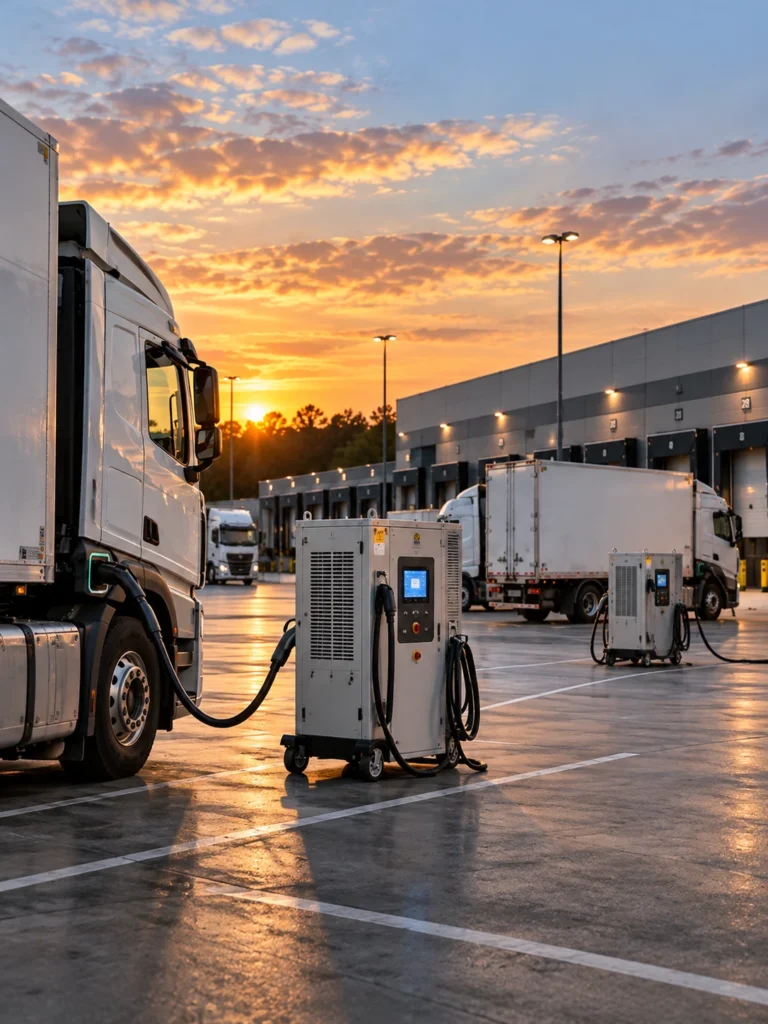
A loaded electric truck sitting at 20 percent is freight that does not move. Bee Charged EV brings on demand Level 3 DC fast charging to your electric trucks at the yard, the dock, the drop lot, and the shoulder of the road, grid free, with the power generated on board and a certified EV technician doing the work. No transformer, no switchgear, no utility interconnection, and no tractor leaving the yard to find a stall. Call 18886759555 and your trucks run tomorrow's lanes.
A tractor waiting on a charger is the most expensive idle asset in your operation. Bee Charged EV brings grid free Level 3 DC fast charging from 60 kW to 540 kW, and higher when the truck takes it, to your terminals, drop lots, ports, and roadside breakdowns, with certified EV technicians, reporting per truck and per lane, and coverage around the clock, nationwide.
Call 18886759555 and tell us how many trucks need charging tonight.
Call NowElectric Truck Fleet Charging Challenges
Lost Charging Time Means Lost Freight Hours
Electric truck fleets lose freight hours because a truck pack is many times the size of a car pack, and the public network was built for cars. Medium duty trucks carry roughly 100 kWh to 300 kWh. Class 8 tractors carry several hundred kilowatt hours and more. Filling that at a stall meant for a sedan turns a 45 minute stop into a half shift.
Truck rated public sites are scarce, and a 75 foot combination cannot pull into a retail stall built for a crossover.
Drivers burn hours of service driving to a charger, queueing, charging, and driving back to the lane.
The depot has 4 chargers and 25 electric trucks, so yard staff shuffle tractors all night.
A depot upgrade for high power charging means a transformer, switchgear, a service upgrade, and a utility interconnection measured in years.
Everything plugs in at the same evening hour, which pushes the site straight into demand charges.
Drop lots, cross docks, and customer yards have no charging at all, so a truck that ends its day there starts the next one short.
Payload, grade, and cold weather pull real range below the brochure figure, which breaks the dispatch plan rather than the truck.
One stranded tractor blocks a dock door and a delivery window at the same time.
The Infrastructure Challenge
Truck rated public sites are scarce, and a 75 foot combination cannot pull into a retail stall built for a crossover. Electric truck fleets need charging that fits the freight operation, not the other way around.
Keep Your Electric Trucks Moving
Bee Charged EV removes the trip. The power comes to the truck, during hours the truck was parked anyway.
Powering the commercial EV fleets and drivers that keep America moving — in every city, all 50 states






Electric Truck Fleet Charging Process
To put on demand EV charging on your trucking operation, give us your yards and your dispatch clock, and we charge inside it in 7 steps.
Call 18886759555 or tap the button and tell us how many electric trucks you run and where they sit between loads.
We map the fleet by class: tractors, straight trucks, yard tractors, and vans, with the connector and the power each one accepts.
We take your duty cycle, which means lane length, payload weight, dwell windows, and the state of charge each truck needs to roll.
Our dispatch team sizes the power per site, because a 30 minute break, a dock turn, and an overnight rest are three different jobs.
A certified Bee Charged EV technician arrives inside an agreed window with the power already generated on board.
Trucks are charged where they sit, in the yard, at the dock, or on the drop lot, with no driver holding a cable and no tractor repositioned.
You receive energy reporting per truck and per lane, ready for cost per mile and for your sustainability numbers.
Your operation does not change. We work around the dock schedule, the driver clock, and the dispatch board.

Electric Truck Fleet Charging Speeds
Charging time is the pack divided by the power, so a 400 kWh tractor takes roughly 4 hours at 100 kW and a little over an hour at 350 kW, before the taper past 80 percent. That is the whole reason power matters more on a truck than on anything else you run. Bee Charged EV delivers 60 kW through 540 kW as standard, and goes higher when the truck can take it, so the charge is sized to the dwell window you actually have.
60 kW is the rescue tier. A tractor came in below plan, a straight truck misjudged the last stop, a yard unit needs enough to finish the shift. It returns working range fast enough to save the load rather than write off the day.
150 kW fits the pause you already have. A truck at a dock door for a live load, or a driver taking the mandated 30 minute break, is dead time for the tractor and working time for the pack. Charge inside it and the next leg starts without a detour.
350 kW is where truck charging stops being a bottleneck. Regional day cabs and medium duty units take serious energy at this rate, and a yard moves through in sequence instead of queueing behind one tractor all night.
540 kW is our standard top tier and the one built for Class 8. Heavy tractors carry the largest packs on the road, and anything less turns an overnight into a two day hold. This resets a line of tractors before the morning dispatch with no substation on your property.
Some trucks accept more, and we deliver more. If your tractor is rated above 540 kW, we size the visit to what the vehicle will actually take, whether that is 700 kW or higher. The rule is simple: whatever an electric truck needs, we bring it to the truck rather than sending the truck to it.
Every pack slows past roughly 80 percent, so we charge to the number your lane needs rather than to full. On a truck that difference is hours, not minutes.
Electric Truck Fleet Charging
Bee Charged EV charges every class of commercial electric truck a logistics operation runs, from a Class 2 van to a Class 8 tractor, in the same yard visit.
Class 8 covers anything over 33,000 pounds gross vehicle weight rating, which is where the heaviest packs and the hardest charging problem live. We charge the Freightliner eCascadia, Volvo VNR Electric, Peterbilt 579EV, Kenworth T680E, and the Tesla Semi at the yard, the rail ramp, or the port drop lot.
Medium duty is the fastest growing slice of electric freight, because the lanes are regional and the duty cycle fits the range. We charge the Peterbilt 220EV, Kenworth K270E and K370E, International eMV, and the Harbinger medium duty chassis now moving into parcel and vocational fleets.
Box trucks run furniture, appliance, and liftgate work, and the gate draws from the same pack that moves the truck. We charge them overnight at the yard or between route blocks, so the gate never pulls the battery below the next delivery window.
Yard tractors work continuously inside the fence line and rarely leave, which makes them easy to electrify and easy to strand when there is no charging on site. We charge terminal units between shift changes so the dock never backs up.
Refuse packers, dump bodies, and vocational chassis stop constantly and run power take off equipment all day. The Mack LR Electric and similar units take high power charging overnight at the operations yard.
Vans close out the freight chain and are usually the first electric units a logistics company buys. We charge the Ford E-Transit, Brightdrop Zevo, Ram ProMaster EV, Rivian electric delivery vans, and Mercedes Benz eSprinter at the station or the staging lot.
Most yards hold a mix: two tractors, a handful of straight trucks, a yard unit, and a row of vans. Our technicians carry every connector and work the yard in sequence, so a mixed class fleet finishes in one visit and bills on one invoice.
Our technicians carry every connector and work the yard in sequence, so a mixed class fleet finishes in one visit and bills on one invoice.

Trucking & Logistics Operations
Each operation below runs a different clock, and each one loses the same way when a truck cannot roll.
Private fleets answer to the business they move freight for, so service level is the whole job. Scheduled yard charging protects the delivery promise without adding a construction project to the facilities budget.
Dedicated operations run against a contract with named service levels and a fixed cost per mile. Charging as a service keeps that cost line predictable and keeps trucks on the contract rather than at a public stall.
Drayage fleets are electrifying faster than almost anyone, because the routes are short and the pressure is local. Turn times decide the money, so charging has to happen inside the staging yard, not across town.
Regional lanes are where electric tractors already work on paper. They stop working when the charging plan assumes a depot still in design. We cover that gap so the lane runs today.
LTL moves freight between terminals on a fixed overnight rhythm. Charging the line haul fleet during the sort window keeps the network on schedule rather than holding freight for a battery.
Final mile runs box trucks and vans on routes with hundreds of stops and a liftgate cycling all day. Charging in the staging lot overnight means every route launches full.
Reefer freight cannot wait, and the cooling unit draws power whether the truck is moving or not. Charging on site protects both the schedule and the load.
Parcel networks are ordering electric trucks in volume. FedEx alone placed an order for 2,000 Harbinger electric trucks worth more than 300 million dollars for the United States and Canada, announced in October 2026. Trucks at that scale arrive long before the depots are ready for them.
Each operation runs a different clock. Mobile charging is scheduled around the yard, the terminal, and the dispatch window.
Electric Truck Connector Coverage
Bee Charged EV brings all 3 connector standards on every visit, because a freight yard is bought across model years and vehicle classes.
CCS1 for the great majority of commercial electric trucks sold in North America, from medium duty chassis through Class 8 tractors.
NACS for the vans, pickups, and light units that use the North American Charging Standard port.
J1772 for slower Level 2 charging where a unit sits through a full rest period.
Give our dispatcher your unit list when you book and the correct connectors arrive with the technician.
Truck Fleet Economics & Uptime Analysis
Fleets weigh 3 options, and on a truck the difference shows up in hours of service rather than cents per kWh.
| What decides it | Public truck charging | Building depot charging | Bee Charged EV mobile charging Mobile |
|---|---|---|---|
| Driver hours lost | Travel, queue, charge, and return, all on the clock | Truck must deadhead back to the yard | ✓ None, the charge happens where the truck sits |
| Time to start | Today, where a truck rated site exists | Transformer, switchgear, and a utility interconnection | ✓ Often the same week you call |
| Upfront cost | None, retail rates per session | Capital for hardware, civil work, and service upgrade | ✓ None, you pay for energy delivered |
| Grid dependency | Tied to that site's capacity | Tied to your interconnection and demand charges | ✓ Grid free, the power is generated on board |
| Class 8 access | Few sites take a 75 foot combination | Needs pull through stalls designed for it | ✓ We come to the truck, parked as it is |
| Power available | Whatever that site installed | Fixed at whatever you built | ✓ 60 kW to 540 kW as standard, higher on request |
| Drop lots and customer yards | Not a solution | Not your property to build on | ✓ Served on the same schedule as your own yard |
| Peak freight season | Queues worsen when volume peaks | Limited to the stalls you built | ✓ Extra capacity dispatched for the season |
| Reporting | Scattered driver receipts | Needs its own software | ✓ Energy per truck and per lane, included |
Travel, queue, charge, and return, all on the clock
Truck must deadhead back to the yard
✓ None, the charge happens where the truck sits
Today, where a truck rated site exists
Transformer, switchgear, and a utility interconnection
✓ Often the same week you call
None, retail rates per session
Capital for hardware, civil work, and service upgrade
✓ None, you pay for energy delivered
Tied to that site's capacity
Tied to your interconnection and demand charges
✓ Grid free, the power is generated on board
Few sites take a 75 foot combination
Needs pull through stalls designed for it
✓ We come to the truck, parked as it is
Whatever that site installed
Fixed at whatever you built
✓ 60 kW to 540 kW as standard, higher on request
Not a solution
Not your property to build on
✓ Served on the same schedule as your own yard
Queues worsen when volume peaks
Limited to the stalls you built
✓ Extra capacity dispatched for the season
Scattered driver receipts
Needs its own software
✓ Energy per truck and per lane, included
Most fleets run all 3. They build at the hub where the volume justifies it, use public charging in a pinch, and hand the daily, drop lot, and peak volume to Bee Charged EV, because that is the part that decides whether the load moves.
Fleet Utilization & Cost Per Mile Protection
Cost per mile comes down to 2 things: how many revenue miles the asset turns, and what you spend keeping it able to turn them. Charging moves both, and it moves them harder on a truck than on anything else, because a tractor costs more per idle hour than anything in the yard.
A truck charged where it parks runs the lane instead of waiting on a stall, so the fleet moves more freight without adding tractors.
The 11 hour driving limit inside a 14 hour window is finite, and a charging detour spends it on nothing. Charging during the mandated 30 minute break gives those hours back to driving.
No tractor returns empty to a depot for power, which is the quietest fuel cost in an electric fleet.
The yard never sees an evening spike, because the energy never comes off your meter.
You add charging capacity without hardware fixed to a yard you may not hold on the next lease.
Reporting per truck and per lane turns charging into a number that goes into the rate rather than a surprise on the P and L.
Enterprise Fleet Advantages
Whatever the truck needs, we bring it.
60 kW to 540 kW as standard and higher when the vehicle accepts it, sized per unit rather than sold as a package.
Every class, from van to Class 8.
One provider, one visit, one invoice, whatever is parked in the yard.
Grid free power.
No transformer, no switchgear, no interconnection queue, and no demand charges on your meter.
Federal government certified company.
Bee Charged EV is a federal government certified EV charging provider, which clears the vendor review shippers, ports, and public agencies run before they sign.
Drop lots and customer yards covered.
Equipment is charged wherever the freight left it, not only where you own the ground.
Agreed arrival windows and roadside response.
Scheduled visits land inside a committed window, and a stranded tractor is charged where it stopped, with no heavy duty tow.
24 hours a day, nationwide.
Freight does not keep office hours, so neither do we, across one terminal or a whole network.
Posted on Google
 Tedros Kefetew
Trustindex verifies that the original source of the review is Google.
Hats off to ‘Bee Charged Emergency Charge’ for the quick save on my electric vehicle – turned a potential breakdown into a minor pit stop. A must-have for any EV owner in need of a swift, dependable charge on the road!”Posted on Google Just NeneGood service , fixed it fast , and found the right tire for mePosted on Google
 Priscila AvinaGood service, kind and professional, I recommend totally. Antony is a good worker and he knows exactly what to do.Posted on Google
 Baltimore DetroitBest service and Quick I would highly recommend these technicians have great knowledgePosted on Google
 Helen CastilloQuick and helpful also very kind thank youPosted on Google
 Taylor SimmonsCan't thank BeeCharged EV enough! They were super quick to respond and had me back on the road fast. Definitely will recommend.Posted on Google
 Uni BizI was in a real pinch when my electric car's battery was running low, and I didn't have a charging station nearby. That's when I called Bee Charge, and they came through like champs! The team was super friendly and professional, showing up promptly to my location. They got my car juiced up efficiently, and I was back on the road in no time. Definitely recommend Bee Charge for any EV drivers in need of a fast, reliable mobile charging service. Two thumbs up from this satisfied customer!"Posted on Google
 XNickBig thanks to Bee Charge for the lifesaving assist – you guys always come through when it counts the most! Love you!Posted on Google
 Kylan“I recently used Bee Charge at an outdoor festival and was impressed by its speedy and efficient service. The charging station was user-friendly and surprisingly affordable, adding convenience to my day without any hassle. What stood out most was their eco-friendly approach, aligning perfectly with my values. Bee Charge is a reliable, eco-conscious solution for anyone needing a quick mobile charge on the go.”Posted on Google
 Jay Val: “Stranded in Temecula, Bee Charge quickly saved the day. Fast, reliable – a real EV lifesaver!”
On demand EV charging for electric trucks is charging delivered to the truck instead of the truck being driven to a charger. Bee Charged EV sends a certified EV technician with a grid free Level 3 DC fast unit to your yard, dock, drop lot, or roadside location, and charges each truck to the state of charge its next lane needs.
Yes. 60 kW to 540 kW is our standard range, and we go higher when the truck accepts higher. If a tractor is rated for 700 kW or beyond, we size the visit to what the vehicle will take. Tell our dispatch team the unit and the rate it accepts, and that is what arrives.
Megawatt charging exists for en route corridor stops, where a tractor has minutes rather than hours. Fleets charging at the yard, the drop lot, or during a mandated break have a longer window, and on demand charging fills it without anyone building a corridor site. Where a truck genuinely needs more than 540 kW, we deliver more than 540 kW.
Logistics fleets skip the build by contracting charging as a service. Our units generate their own power, so no transformer, switchgear, service upgrade, or utility interconnection is involved, and the yard's existing electrical capacity is never touched.
Trucking fleets stay charged by using time the truck is already stopped, which means the overnight yard, the dock turn, and the driver's mandated break. Bee Charged EV schedules into those windows, so charging never competes with the dispatch clock.
Yes, and that break is one of the best windows on the clock. The truck is stopped by regulation, the driver is off duty, and the pack gains range in time the load was already losing. Our technician handles the connection so the break stays a break.
Level 3 DC fast charging is the only practical choice for commercial trucks, because truck packs are far larger than car packs and the operating windows are shorter. Level 2 still has a place for light units sitting through a full rest period, where speed buys nothing.
Yes, Class 8 electric semi trucks are charged at the yard or wherever the combination is parked. A tractor and trailer never has to fit a stall built for a car, which removes the access problem public charging creates for heavy freight.
Yes, that is the point of the service. The truck stays where the freight left it, at a drop lot, a customer yard, a rail ramp, or the shoulder, and the charging comes to it. No deadhead miles and no lost place in a queue.
Yes, every unit is grid free and carries its own generation. Gravel overflow lots, unpowered drop lots, port staging areas, and terminals still waiting on an electrical service all work the same as a fully wired yard.
Yes, weight is the biggest draw on a truck pack, along with grade and speed. A loaded tractor returns with far less range than the same unit running empty, so we set target state of charge against the actual lane and payload rather than a rated range figure.
Yes, cold cuts usable range and slows the rate a pack accepts power, and a reefer or cab heater pulls from the same battery. Winter lanes need higher target charge levels and more frequent visits, which we build into the schedule rather than discovering mid season.
No, drivers never handle a connector and never wait with the unit. Our certified EV technician manages every connection, so the driver takes their break, goes home, or runs the next assignment while the truck charges.
Public networks were built around cars. Truck rated sites are scarce, most stalls cannot physically take a 75 foot combination, and the power levels were chosen for packs a fraction of the size. Counted properly, a public session also costs the drive out, the queue, and the drive back, all against hours of service, which is where it quietly becomes the expensive option.
No, there is no minimum. We charge a single stranded tractor and we charge yards holding dozens of units. Smaller carriers often feel it fastest, because one truck down out of 5 is a fifth of the week's capacity.
Yes, the overnight yard is our most common booking in freight. Trucks sit parked and locked, our technician works the line in sequence at the power each class takes, and the morning dispatch goes out with every unit at its target state of charge.
Yes, emergency charging is available for any truck that stops short. Give us the location and the unit, and a technician reaches it and returns enough range to move the freight, which costs far less than a heavy duty tow and a missed delivery window.
Overnight at the yard carries most fleets, with a second daytime visit for equipment working a second shift or sitting at a drop lot. Bee Charged EV runs 24 hours a day, so the schedule follows the freight rather than business hours.
Yes, recurring visits run to an agreed window so your yard supervisor knows exactly when we arrive. Emergency calls are dispatched on receipt, and we give you a realistic time to the truck rather than an open ended promise.
Drayage pays on turns, so leaving the staging area to charge costs the appointment as well as the time. We charge inside the staging yard between turns, which keeps the tractor in position and the appointment intact.
Four moves carry most of it. Charge overnight while the truck is parked, so charging never spends driver hours. Charge to the lane requirement rather than to full, since the last portion of a pack is the slowest to fill. Cover drop lots on a scheduled visit instead of deadheading tractors home. And track energy per truck and per lane, so a weak pack or a badly planned lane is caught before it costs a load.
Yes, every session reports kWh delivered, start and finish state of charge, time, location, and cost for each unit. Fleet managers use it for cost per mile, for billing a dedicated contract accurately, and for spotting the tractor whose energy draw has quietly climbed.
Yes, peak season is where mobile charging earns its place. Extra trucks, overflow lots, and extended dispatch windows all need more charging for a few weeks, which is the worst possible reason to build permanent infrastructure. We dispatch additional capacity for the season and scale back when volume settles.
Yes, and small fleets often get the clearest return, because a depot build can never be justified for 3 or 4 units. Those trucks still need high power charging, and a scheduled visit gives them the same readiness a large carrier gets from its hub.
Put one yard or one lane on a scheduled window for a few weeks. You measure revenue miles recovered, driver hours saved, and energy cost per mile against what that operation spent before, and the reporting from the pilot supports the wider rollout.
Bee Charged EV serves freight operations nationwide, including California, Nevada, Arizona, Colorado, Texas, Florida, Georgia, North Carolina, South Carolina, Tennessee, Kentucky, Illinois, Michigan, Minnesota, Ohio, New York, New Jersey, Pennsylvania, Massachusetts, Maryland, Virginia, Washington, and Washington DC. Call us to confirm coverage for a specific terminal, port, or drop lot.
A tractor waiting on a charger is the most expensive idle asset in your operation. Bee Charged EV brings grid free Level 3 DC fast charging from 60 kW to 540 kW, and higher when the truck takes it, to your terminals, drop lots, ports, and roadside breakdowns, with certified EV technicians, reporting per truck and per lane, and coverage around the clock, nationwide.
Call 18886759555 and tell us how many trucks need charging tonight.