
Step 01
Call 18886759555 and tell us the yard address, how many electric buses you run, and when the first route leaves.

Keep commercial EVs moving with flexible mobile charging support for fleets, depots and business operations.
Get mobile EV charging delivered directly to your location when you need it.
Book Mobile Charging Request a charging serviceNationwide Bus Fleet EV Charging
First route pulls out at 6:10. Two buses came back short yesterday, and the yard has 4 chargers for 11 electric buses. Bee Charged EV brings the energy to the lot and charges the buses where they are parked , grid free, with a certified EV technician handling every connection. No utility application. No transformer sitting in a queue. No driver sent across town to find a public charger. Call 18886759555 and on demand EV charging reaches your buses before the morning run.
A bus that will not pull out is a route nobody covers. We bring grid free DC fast charging from 60 kW to 540 kW, and higher when the bus takes it, to your depots, your satellite yards, your layovers and your charter stops, any hour, nationwide.
Call 18886759555 and tell us which buses need charging tonight.
Call NowThe Electric Bus Fleet Charging Bottleneck
Buses Arrive Before the Chargers Do
Because buses arrive long before the chargers do. The grant lands, the order ships, the buses show up on the lot, and the depot build is still an application sitting with a utility. Meanwhile every route has a hard departure time and no slack in it.
New electric buses parked on the lot while the service upgrade waits on a transformer.
Charger count lands behind bus count, so a dispatcher picks which buses charge tonight.
A bus comes back from an athletic run at 10 percent and it is on a route at 6 a.m.
One charger fails and 3 buses suddenly have nowhere to plug in before a school day.
Field trip runs 90 miles round trip and the yard is the only charger within reach.
Buses sit through summer break and come back to packs nobody has touched in 10 weeks.
The Fleet Operations Challenge
A bus comes back from an athletic run at 10 percent and it is on a route at 6 a.m. Meanwhile, every route has a hard departure time and no slack in it.
Keep Every Bus Ready for Its Route
On demand EV charging takes that whole problem off your dispatcher. You tell us which buses and what time the first route leaves, and the fleet is ready before drivers pick up keys.
Powering the commercial EV fleets and drivers that keep America moving — in every city, all 50 states






Bus Fleet Charging Process
One call sets it up, and after that it runs quietly around your route schedule. Here is the whole process.
Call 18886759555 and tell us the yard address, how many electric buses you run, and when the first route leaves.
We go through the fleet list: bus type, make, battery size and what each one plugs into.
We map the charging to your route sheet, which means overnight, the midday gap, or both.
We sort out yard access with your transportation director, so gate hours and parking rows are settled before day one.
We clear your compliance file first, which means an insurance certificate naming your district or agency, background checked technicians, and whatever site induction your schools require.
Our certified EV technician arrives inside the agreed window with the energy already on board, and charges each bus where it is parked.
You get kWh per bus and per route, so charging reconciles against your transportation budget and your grant reporting.
Nothing installed, nothing permitted, nothing left in the yard overnight.

Electric Bus Fleet Charging Power
Depends on how long the bus sits and how much it has to give back. We bring 60 kW through 540 kW, and higher when a bus accepts higher, so pick the situation that matches your yard.
A single bus limped in at 12 percent after an activity run. It does not need the whole yard treatment, it needs enough energy to cover tomorrow's route. We put that back in overnight while it sits in its row.
Buses are back on the lot by 9:15 and nothing moves until 2. That is close to 5 hours of dead time, and at this power a Type C school bus goes from a thin battery to comfortable for the afternoon run with hours to spare.
Nine buses parked, every one of them on a route at 6 a.m., and your depot cannot cover them all in one night. One visit, one sequence, the rest of the fleet at working charge before drivers arrive. This is the tier that saves a morning.
A 40 foot transit bus or an electric motorcoach carries far more battery than a school bus, and charging one of those at low power eats the entire night. This tier turns them around on a layover or in the yard with no substation anywhere near you.
Some coaches and transit buses accept higher, so we deliver higher. Tell us the model and what it is rated to take, and that is what arrives. The energy travels to the bus rather than the bus hunting for the energy.
One thing worth knowing about every bus battery: charging slows right down past 80 percent. We charge to what the next route actually needs, which usually means one visit instead of two.
Electric Bus Fleet Types We Charge
If it carries passengers and it plugs in, we charge it. Same visit, same invoice.
The yellow bus most districts start with. Thomas Built Saf-T-Liner C2 Jouley, Blue Bird Vision Electric, IC Bus CE Series Electric, Lion Electric LionC. Two routes a day plus an activity run empties one faster than the spec sheet suggests, so we charge them in their rows and the morning never opens with a range conversation.
Bigger body, bigger pack, longer rural routes. Saf-T-Liner HDX, Blue Bird All American RE Electric, Lion Electric LionD, GreenPower BEAST. These are the buses a district puts on the 70 mile run, and they come back needing real energy rather than a top up.
Micro Bird G5, GreenPower Nano BEAST, GreenPower EV Star and similar small buses. They run door to door, which means more stops, more idling and more cabin heat than a standard route. We charge them alongside the big buses so a special needs run never waits on a battery.
New Flyer Xcelsior CHARGE, Gillig Battery Electric, Proterra ZX5, BYD K series, Nova Bus LFSe+. Service runs 16 hours or more and the depot was never built for that load. We charge in the yard overnight or at a layover point, so headways hold and no run gets pulled.
Short loops all day, which looks easy until you add up the miles. University circulators, hotel and airport shuttles, hospital and employee loops. Most of these operators have no yard of their own, so charging that comes to the curb is the only version that works.
MCI J4500 CHARGE, Van Hool CX45E and the rest of the electric coach fleet. A coach parks at a hotel, a stadium or a venue lot, never at a depot, and a charter day is long. We meet the coach where it overnights so the return trip is never in question.
The runs that break a charging plan. A game two counties over, a field trip, a band competition on a Saturday. These trips exceed a normal route by a wide margin, so we charge at the destination or back at the yard and the next school day is unaffected.
Demand response service covers unpredictable mileage, so the battery never ends the day in the same place twice. Scheduled visits keep the whole paratransit fleet ready without a dispatcher guessing which vehicle can take the next trip.
Every real fleet runs both for years. The electric buses land in whatever rows are free, usually nowhere near the chargers, and the yard was striped for fuel trucks. We charge them where they actually park instead of making you restripe a lot mid transition.
Six Type C buses, 2 Type A vans and a transit coach is a normal mixed list. Our technician carries every connector and works straight down it, so you deal with one visit and one invoice instead of three vendors and a spreadsheet.
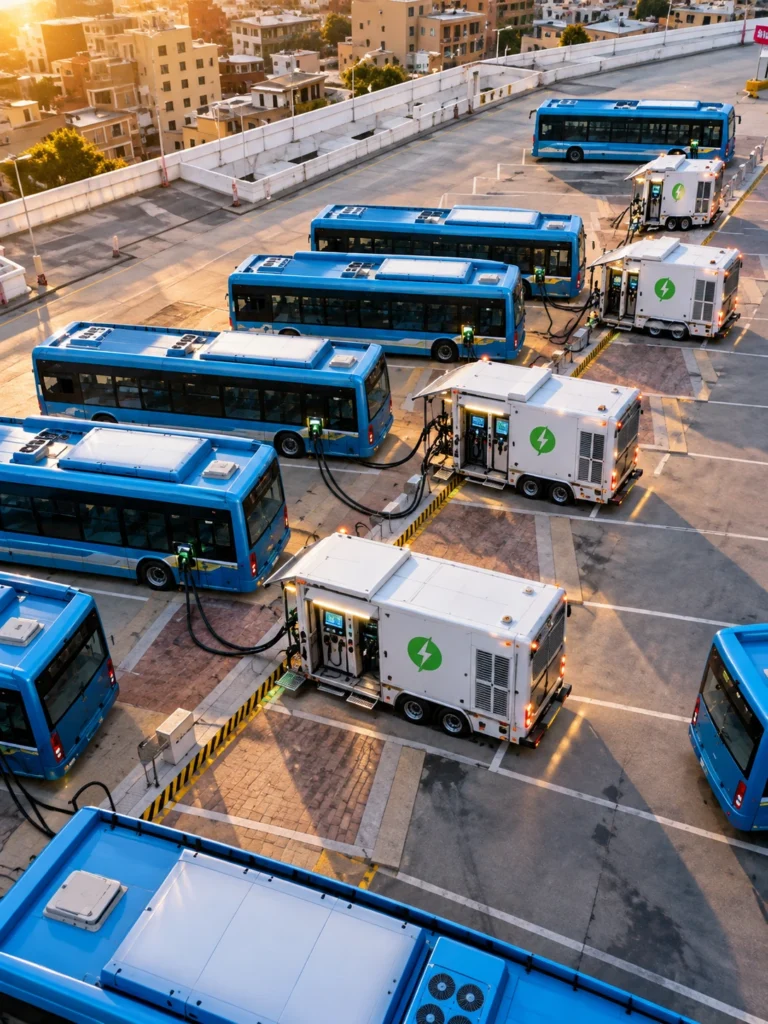

Bus Fleet Charging Locations
Nine places your buses sit, and most of them have no charger at all.
The standard visit. Buses parked in rows, drivers gone, and we work the list so the gate opens on a charged fleet.
Where the capital case for a charging build never adds up. A recurring visit covers those buses without a service upgrade on ground you hand back.
Trenching across the lot, chargers energized in phases, or the whole operation moving to a new yard. Charging stays with the buses through all of it, so the construction schedule never decides which routes run.
One unit down takes several buses with it, and a route has a departure time rather than a window. A same day visit covers the buses that lost their charger, which is the redundancy a service contract assumes you already have.
Buses sit for 10 weeks and packs drift down the whole time, so the first week back opens on buses nobody can move. A maintenance visit through the break keeps the fleet ready, and summer school and camp routes get charged on the reduced schedule they actually run.
Some buses stage at a school rather than returning to the yard. We charge them where they stage, which protects the afternoon run and saves a deadhead trip each way.
A bus sitting at the end of the line is an opportunity, not a gap. Charging at the layover keeps the block running and avoids building a high power site at every terminal.
Hotel lots, stadium lots, venue parking and campgrounds. No charger for miles, and the bus has to get everyone home. We meet it at the destination overnight.
A bus stopped with passengers on board is the worst phone call in the building. We reach it where it stopped and put in enough to finish the trip, with no tow and no riders left waiting.
From depots and satellite yards to layovers, charter destinations and roadside locations, mobile EV charging comes to where your buses are parked or staged.
Bus Fleet Operators We Serve
Different schedules and different funding, same problem the moment a bus will not pull out.
You own the routes, the drivers and the complaints. Charging that covers the buses your depot cannot reach keeps every route on time while the permanent build works through its queue.
You run district routes from yards you often lease, under a contract with service penalties in it. Charging as a service protects your on time performance without putting capital into ground that is not yours.
Fixed route service, published headways and a board watching both. Bee Charged EV is a federal government certified EV charging provider, so procurement review on federally funded service is already handled.
Universities, airports, hospitals and employers run constant short loops with no depot built for charging. We charge at the curb or in the staff lot, on the schedule the loop allows.
Your coaches are rarely home. Multi day itineraries, hotel parking and venue lots make depot charging close to useless, which is exactly the case charging on demand was built for.
Parks shuttles, senior transport, correctional and employee buses sit under procurement rules and emissions reporting. The energy documentation comes with the service rather than becoming another staff task.
Medical appointments and demand response trips cannot slip. Scheduled charging keeps the whole fleet available without anyone tracking which vehicle has range for the next pickup.
Buses move people when a storm hits and the grid is down, which is the moment depot chargers are least useful. Our units carry their own energy, so an evacuation fleet keeps rolling through an outage.

Bus Fleet Connector Coverage
All 3 arrive on every visit, because no fleet electrifies in one purchase order.
CCS1 for electric school buses, transit buses and coaches using the standard DC fast port.
NACS for light buses and support vehicles on the North American Charging Standard.
J1772 for Level 2, which still covers plenty of Type A buses and shuttles sitting overnight.
Buses fitted for overhead pantograph charging keep a plug port as well, and that is the port we use. Send us the fleet list when you book and the right ends arrive with the technician.
Bus Fleet Charging Comparison
Three ways to keep electric buses charged. Here is how they compare on the things a transportation director answers for.
| What decides it | Permanent depot charging build | Generator plus rented chargers | Bee Charged EV on demand charging Mobile |
|---|---|---|---|
| Time to first charged bus | Application, permit, transformer, and often a year or more | Days, once delivery and setup line up | ✓ Often the same week you call |
| What you pay upfront | Capital for service, switchgear and chargers | Rental, delivery and a fuel account | ✓ Nothing, you pay for the energy delivered |
| Effect on your utility bill | A new demand peak every time the fleet plugs in | A fuel line instead of a power line | ✓ No added demand on your meter |
| Who does the work | Your staff, every night | Your staff refuels it | ✓ Our certified EV technician, every visit |
| One charger fails | Those buses have nowhere to go | Whole site goes down with the generator | ✓ We cover the buses that lost a charger |
| Buses at a leased or satellite yard | Rarely worth the capital | Possible, with a fuel problem attached | ✓ Same service as the main depot |
| Grid outage or storm | Down with the grid | Works while fuel lasts | ✓ Grid free, the energy arrives with us |
| Buses away from the yard | No help at all | No help at all | ✓ Field trips, layovers, roadside, anywhere |
| Charging speed | Whatever service you paid for | Whatever the generator allows | ✓ 60 kW to 540 kW, higher on request |
| What you can report | One meter for the whole yard | Fuel tickets | ✓ kWh per bus and per route |
Application, permit, transformer, and often a year or more
Days, once delivery and setup line up
✓ Often the same week you call
Capital for service, switchgear and chargers
Rental, delivery and a fuel account
✓ Nothing, you pay for the energy delivered
A new demand peak every time the fleet plugs in
A fuel line instead of a power line
✓ No added demand on your meter
Your staff, every night
Your staff refuels it
✓ Our certified EV technician, every visit
Those buses have nowhere to go
Whole site goes down with the generator
✓ We cover the buses that lost a charger
Rarely worth the capital
Possible, with a fuel problem attached
✓ Same service as the main depot
Down with the grid
Works while fuel lasts
✓ Grid free, the energy arrives with us
No help at all
No help at all
✓ Field trips, layovers, roadside, anywhere
Whatever service you paid for
Whatever the generator allows
✓ 60 kW to 540 kW, higher on request
One meter for the whole yard
Fuel tickets
✓ kWh per bus and per route
Most fleets end up running two of these. A permanent build for the core of the yard once it is energized, and us for the buses it cannot reach, the satellite lots, the trips away from the depot and the nights a charger is down.
Bus fleets are judged on routes covered and money spent correctly, not on cents per kWh. Charging decides both.
A charged yard means no bus swaps, no doubled runs and no call to a transportation director at 5 a.m.
Federal money moved 5 billion dollars into electric school buses through the EPA Clean School Bus Program, and a bus parked waiting on a transformer is funding sitting idle.
The energy comes in on our units, so charging the fleet never resets the demand charge on your building.
You never put capital into chargers on a leased lot or a yard you are about to relocate.
kWh per bus against route miles tells you what a route really costs in energy, so the permanent build gets sized on your numbers instead of a brochure.
kWh per bus and per route goes straight into transportation budgets and the energy documentation funders keep asking for.
Nobody on your payroll spends a shift shuffling buses between chargers or handling a cable.
Buses run from the week they arrive instead of waiting on a service upgrade.
No application, no permit, no transformer, no dependence on a connection that does not exist yet.
60 kW to 540 kW as standard, higher when a coach or transit bus accepts higher, Level 2 for small buses overnight.
School buses, transit buses, shuttles, coaches and paratransit vehicles, one invoice.
We are a federal government certified EV charging provider, which clears procurement review on publicly funded student and transit service.
Insurance certificate naming your district or agency, background checked technicians, site induction completed, yard access agreed before the first visit.
Pre dawn starts, midday gaps, late transit blocks, weekend charters, summer breaks, one yard or a whole region.
Posted on Google
 Tedros Kefetew
Trustindex verifies that the original source of the review is Google.
Hats off to ‘Bee Charged Emergency Charge’ for the quick save on my electric vehicle – turned a potential breakdown into a minor pit stop. A must-have for any EV owner in need of a swift, dependable charge on the road!”Posted on Google Just NeneGood service , fixed it fast , and found the right tire for mePosted on Google
 Priscila AvinaGood service, kind and professional, I recommend totally. Antony is a good worker and he knows exactly what to do.Posted on Google
 Baltimore DetroitBest service and Quick I would highly recommend these technicians have great knowledgePosted on Google
 Helen CastilloQuick and helpful also very kind thank youPosted on Google
 Taylor SimmonsCan't thank BeeCharged EV enough! They were super quick to respond and had me back on the road fast. Definitely will recommend.Posted on Google
 Uni BizI was in a real pinch when my electric car's battery was running low, and I didn't have a charging station nearby. That's when I called Bee Charge, and they came through like champs! The team was super friendly and professional, showing up promptly to my location. They got my car juiced up efficiently, and I was back on the road in no time. Definitely recommend Bee Charge for any EV drivers in need of a fast, reliable mobile charging service. Two thumbs up from this satisfied customer!"Posted on Google
 XNickBig thanks to Bee Charge for the lifesaving assist – you guys always come through when it counts the most! Love you!Posted on Google
 Kylan“I recently used Bee Charge at an outdoor festival and was impressed by its speedy and efficient service. The charging station was user-friendly and surprisingly affordable, adding convenience to my day without any hassle. What stood out most was their eco-friendly approach, aligning perfectly with my values. Bee Charge is a reliable, eco-conscious solution for anyone needing a quick mobile charge on the go.”Posted on Google
 Jay Val: “Stranded in Temecula, Bee Charge quickly saved the day. Fast, reliable – a real EV lifesaver!”
Charging that travels to your buses instead of your buses driving to a charger. We send a certified EV technician with a grid free DC fast unit, and every bus gets charged where it is parked, to whatever level the next route needs.
You give us the yard, the fleet list and the time the first route leaves. Our technician arrives inside that window with the energy already on board, works down the rows, and leaves nothing behind. Nothing is installed and no bus moves to get charged.
Often the same week you call, because there is nothing to build. One call covers the yard, the fleet list and access, and the first visit follows. Compare that against a depot build, where the transformer alone can hold a project for months.
With a midday visit, which is the easiest charging window a district has. Buses are back by around 9:15 and idle until 2, so a technician works through the fleet in that gap and sends every bus out comfortable for the afternoon run.
Yes, and school buses suit it better than almost any fleet. They park in predictable rows, they sit idle for long blocks, and they use the same CCS1 port our units carry. Type A, Type C and Type D buses all get charged in the same visit.
Yes, and that is why we book a window rather than a fixed slot. Downtime is the midday gap for a school bus, a layover for a transit bus, or a hotel overnight for a coach. We charge inside that time instead of taking a bus out of service.
Yes. Our units deliver DC fast charging from 60 kW to 540 kW, and higher where a transit bus or coach is rated to accept it. The bus does not need to be near a DC fast station, because the station is what arrives.
Fast enough to fit the gap you have. A Type C school bus on a higher power tier recovers an afternoon route inside the midday window with hours to spare, while a 40 foot transit bus or a coach carries far more battery and wants a high power overnight visit. We size the power to your window rather than making you work around ours.
The whole list, worked in sequence. A higher power tier simply moves through more buses per hour, so a full yard is a single booking rather than a scheduling exercise.
No. Our technician makes every connection, monitors the session and disconnects, so charging never lands on a driver's time card or your maintenance shop. It also keeps the whole activity off your safety plan.
Yes, and we clear it before the first visit rather than at the gate. Technicians are background checked, we send a certificate of insurance naming your district or agency, and our crew completes whatever site induction and identification your schools require for anyone working on their property.
Four things decide whether it works. Size the charging against real route energy rather than the brochure, because a 70 mile rural route and a 25 mile town route are different buses by 2 p.m. Keep the whole fleet off the chargers at the same moment, since that single peak is what sets your demand charge. Cover the satellite and leased yards from day one instead of treating them as a later phase. And put charging on the buses before the depot build finishes, so the fleet starts earning the week it arrives.
Buying a battery unit from a manufacturer leaves you owning the asset and all of its logistics, since it still has to be delivered, placed, secured, recharged and collected by somebody on your staff. Bee Charged EV delivers the same grid free energy to the same buses as a service, so nothing sits in your yard to insure, maintain or find space for.
On the money that leaves this year, almost always, because there is no service upgrade, no switchgear, no chargers to buy and no new demand charge on your meter. You pay for energy delivered to buses that are running routes. Send us your yard and fleet list and we will price it against the quote you are holding.
Because more chargers fix only the buses standing in front of them. They do not help a bus on a field trip, a coach at a hotel, a satellite yard, a storm that takes the grid down, or the night one unit fails and takes 3 routes with it. Charging that travels covers every one of those, and it arrives this month rather than next year.
Bee Charged EV, nationwide and around the clock. A bus stopped with passengers on board, a depot charger down the night before a school day, or an evacuation fleet during an outage are all the same dispatch to us, because our units do not need a working grid connection.
Yes, on the road or in the yard. Give us the location and the bus, and a technician reaches it and puts in enough to finish the trip or cover the next route, with no tow and no riders left waiting.
Yes, and those runs are where charging plans usually break. A game two counties over or a Saturday competition puts a bus well past a normal route, so we charge at the destination lot or the hotel overnight and the next school day is unaffected.
All of them, often in the same yard. Transit buses on fixed route service, campus and airport shuttles, electric motorcoaches on charter work, paratransit vehicles and activity buses are all part of what we charge on demand.
By adding the capacity as a scheduled visit instead of a construction project. A bus driven to a public charger loses the trip there, the queue and the trip back, all on your clock. Charging that comes to the row the bus is parked in costs you none of that.
Overnight suits most yards, so the fleet is ready at first light. Districts add a midday visit in the gap between routes, and transit and charter operators book around layovers, shift changes and hotel stops. Our on demand EV charging runs 24 hours, so the schedule follows your route sheet.
Yes, more than most districts expect. A pack left alone for 10 weeks drifts down, so the first week back can open on buses that will not move and a shop with no time to deal with it. A maintenance visit through the break keeps the fleet ready, and summer school and camp routes get charged on whatever reduced schedule they run.
Yes, and that is one of the most common reasons districts call. Buses funded through the EPA Clean School Bus Program often arrive before the depot chargers are energized, and charging delivered to the yard puts those buses into service on time rather than leaving awarded funding parked on a lot.
No minimum. One electric bus at a small district or a full transit yard both work. Small fleets often feel it fastest, because losing 1 bus out of 4 is a quarter of your routes.
Charge in the windows the route sheet already gives you, midday and overnight, so charging never costs a run. Charge to what the next route needs rather than to full, since the last 20 percent takes the longest. Put satellite yards and away trips on scheduled visits instead of deadheading buses home. And watch kWh per bus, so a tired pack shows up before it cancels a route.
Yes. kWh delivered, start and finish charge, time, location and cost, for every bus. Districts and agencies use it for transportation budgeting, for grant reporting, and for proving a route is actually within range before committing another bus to it.
Put one yard on a schedule for a few weeks. Count the routes that pulled out on time, the bus swaps you stopped making, and the energy cost per bus against what that operation was spending before. That is the number you take to the board.
Nationwide, including California, Nevada, Arizona, Colorado, Texas, Florida, Georgia, North Carolina, South Carolina, Tennessee, Kentucky, Illinois, Michigan, Minnesota, Ohio, New York, New Jersey, Pennsylvania, Massachusetts, Maryland, Virginia, Washington and Washington DC. Call and we will confirm your yard address.
A bus that will not pull out is a route nobody covers. We bring grid free DC fast charging from 60 kW to 540 kW, and higher when the bus takes it, to your depots, your satellite yards, your layovers and your charter stops, any hour, nationwide.
Call 18886759555 and tell us which buses need charging tonight.