
Step 01
Call 18886759555 or tap the button below and tell us how many electric cabs or rideshare EVs you run and where they sit between shifts.

Keep commercial EVs moving with flexible mobile charging support for fleets, depots and business operations.
Get mobile EV charging delivered directly to your location when you need it.
Book Mobile Charging Request a charging service
Nationwide Ride Hailing & Taxi EV Charging
Your electric taxi earns nothing while it sits at a charger, and your best drivers already know it. That is the real problem with rideshare electrification today: the cars are ready, the fares are there, and charging still pulls drivers off the road for 40 minutes at a stretch, usually during the busiest hours of the shift. Bee Charged EV takes that hit away by sending Level 3 DC fast charging to wherever your ride hailing EVs already sit, whether that is an airport staging lot, a taxi stand, a driver hub, a depot at 3 a.m., or a curb downtown between fares. Certified EV technicians arrive with the power already on board, plug in, and hand the car back ready for the next ride request. Call 18886759555 and we will build the charging around your shift board instead of the other way round.
The Cost of Charging Downtime
Peak demand and charging collide
A ride hailing EV loses its best hours because charging and earning want the same time of day. Friday at 6 p.m. is when fares surge, and it is also when every rideshare driver in the city needs power. Your driver joins a queue behind 4 other cars, waits, charges, then drives back into a surge that has already cooled off.
The math punishes high mileage work harder than anything else on the road. A personal EV covers maybe 40 miles a day and charges overnight at home. A ride hailing EV can cover 200 miles or more in one shift, so it needs a real charge during working hours, not after them. That gap is where the money leaks out.
Drivers burn paid time travelling to a charging station, queueing, charging, and driving back to the demand zone.
The charger nearest the airport or downtown is the one everyone else wants, so the wait is longest exactly when fares pay the most.
Drivers who rent from a fleet hand the car back with a low battery, and the next driver starts a shift already short.
Apartment based drivers have nowhere to charge overnight, so every single charge happens on paid time.
A taxi yard with 6 chargers and 30 electric cabs becomes an overnight traffic jam somebody has to manage by hand.
Winter cuts real range, so a car that comfortably covered a shift in June comes up short in January.
One broken public charger can strand a driver far from the next working stall.
Remove the charging trip
Bee Charged EV removes the trip entirely. The charging comes to the car, during hours the car was parked anyway, so the shift stays whole.
Powering the commercial EV fleets and drivers that keep America moving — in every city, all 50 states






How Fleet Deployment Works
To deploy on demand Level 3 DC fast EV charging across your fleet, you hand over your shift board and your parking locations, and Bee Charged EV builds the whole charging schedule around them in 7 steps.
Call 18886759555 or tap the button below and tell us how many electric cabs or rideshare EVs you run and where they sit between shifts.
We map the fleet: car models, connector types, daily mileage, and the exact hours each car is idle.
Our dispatch team picks a power tier per location, because an airport lot with 20 minutes of dwell time is a different job from a depot with 8 hours.
We agree the charge level every car must reach before it goes back out, so no driver starts a shift guessing.
A certified Bee Charged EV technician arrives with the power generated on board and every connector in the van.
Cars are charged in sequence while they sit parked and locked, with nobody from your team touching a cable.
You get a report per car and per driver covering kWh delivered, start charge, finish charge, and cost.
Nothing about your operation changes. No construction, no electrical upgrade, no landlord conversation, and no driver sent across town in the middle of a surge.

Fleet Charging Speeds
Level 3 DC fast EV charging is the speed that keeps a ride hailing and taxi fleet earning, because it is the only tier that fits inside the gaps a working shift actually leaves. Level 2 charging pushes roughly 7 kW to 19 kW into a car, which suits a cab parked all night and wastes a driver's afternoon. Bee Charged EV runs 4 tiers of on demand DC fast EV charging, from 60 kW to 540 kW, and our dispatcher matches the tier to the idle window you have at each location rather than selling one speed to every fleet.
60 kW is the rescue tier. One driver misjudged the last hour of a shift, one rental came back near empty, one electric cab needs enough range to finish the night. This tier puts usable miles back quickly enough that the driver keeps the rest of the shift instead of writing it off.
150 kW fits the handover window. A taxi or rental fleet swapping drivers has a short gap between one shift ending and the next starting, and that gap is usually wasted. Charge inside it and the same car covers two full shifts a day, which is how a fleet earns more without buying another car.
350 kW is for places where cars stack up and time is expensive. Airport staging lots, downtown hubs, and high volume taxi stands move far more cars per hour at this tier, so your own drivers are not queueing behind each other waiting for the car in front to finish.
540 kW is our highest tier, built for fleets running dozens of electric cabs out of one yard. It brings a large group of cars to shift ready charge in a single visit, which is the only realistic way to turn a whole depot around before the morning board without building a substation first.
Charging above 80 percent slows down on every EV battery chemistry, so we charge to the number your shift needs rather than the number that looks tidy. That single decision moves more vehicles per hour and keeps more drivers earning.
Fleet Parking Reach
Your cars already sit still for part of every day. That parked hour is the cheapest charging capacity your fleet owns, and it is the hour we work in.
Airport queues are dead time by design. Drivers sit waiting for a ping, sometimes for an hour, in a lot with no charging at all. Charging cars inside that queue turns the slowest part of the day into the most productive one, and your driver rolls up to the terminal with a full battery.
A yard full of electric cabs overnight is the simplest job we do. Cars are locked, drivers are home, energy is at its cheapest hour, and our technicians work through the yard in sequence so every cab is ready before the morning board goes out.
Rideshare rental hubs turn cars around constantly, and a car with a low battery cannot go out to the next renter. We charge between returns and pickups so every handover starts full, which protects your rental day rate and your driver reviews at the same time.
Drivers who work a fixed patch tend to park in the same few spots between fares. Meeting them there, at a break or a meal stop, means the charge happens inside time they were never going to earn in anyway.
Drivers without a private garage are the ones the charging market forgot. They cannot install a home charger, so every charge costs them working hours. Charging the car where it sleeps hands those drivers the same overnight advantage a homeowner already has.
Cabs at a stand are waiting for a customer, not driving. Charging at the rank keeps the car in position and in line, so it never gives up its place just to go find power.
Big events bring the best fares of the month and the worst charging conditions of the month, because every driver in the city arrives at once. Staging our units near the surge zone keeps your cars in the area while everyone else drives away to charge.
A driver stuck on an empty battery is losing money by the minute and usually panicking. Our technicians reach the car where it stopped and put enough charge in to get it back to work, so there is no tow and no lost night.

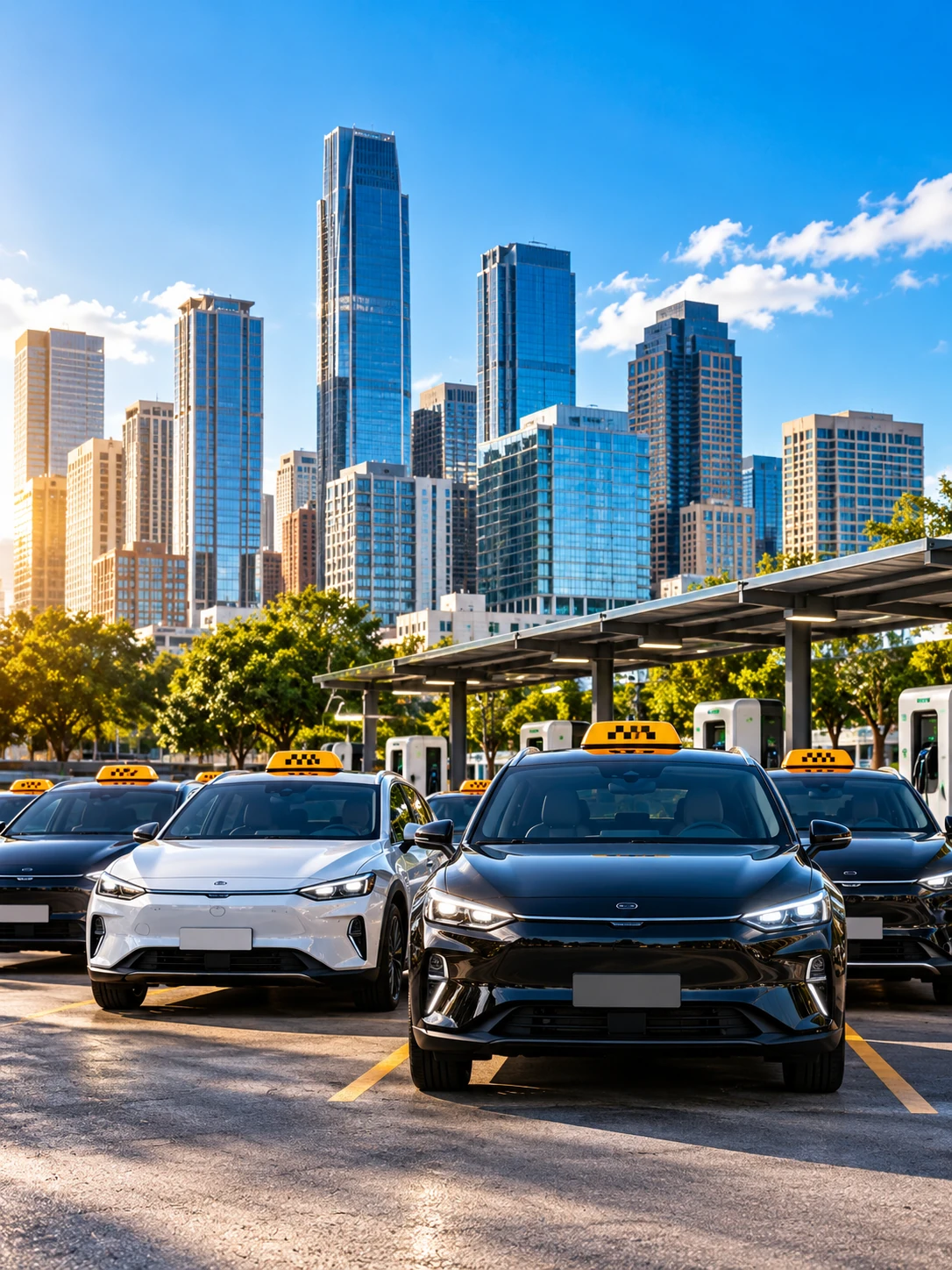
Every operation below has the same problem shaped a little differently, and we plan the charging around the way each one earns.
Companies renting EVs to rideshare drivers live and die on turnaround. A car sitting at 15 percent earns nothing for you and nothing for the driver waiting on it. Charging between rentals keeps your whole inventory rentable instead of half of it plugged in somewhere.
Traditional cab fleets are swapping hybrids for electric cars while running the same 24 hour board. Your yard was built for a fuel pump, not for 30 cars wanting power at once, and rebuilding it takes months you do not have. We cover that gap from the first electric cab to the last.
Executive clients notice a late car and never forgive a dead one. Charging between bookings at the garage keeps your cars presentable and punctual, and it keeps them out of a public charging queue in the middle of an airport run.
Concession fleets run long idle stretches broken up by long trips, which is the hardest rhythm to charge around. Charging inside the holding lot fits that rhythm exactly, and no car ever leaves the queue to do it.
Accessible vehicles carry riders who cannot simply take the next available car, so availability here is service, not just revenue. Scheduled charging keeps every accessible EV in the rotation rather than parked waiting on a free stall.
Medical transport runs to appointment times that do not move. A charging detour is not an inconvenience here, it is a missed dialysis slot. Charging between runs keeps those bookings safe.
The full time drivers your fleet supplies cover 200 miles or more a day, which makes them the heaviest chargers on your books and the ones losing the most hours to it. Charging their car where it sleeps hands the whole next shift back to fares, and it is the single clearest reason a good driver stays on your cars instead of moving to another operator.
Cooperatives and small operator groups that share parking can share a charging visit too. Pooling a handful of cars into one scheduled session gives every member depot grade EV charging without any of them carrying the cost of a depot, which is how a small operator competes with a fleet ten times its size.
Universal Fleet Compatibility
Bee Charged EV brings all 3 connector standards on every visit, because a ride hailing fleet almost never runs one badge of car. Your drivers pick their own vehicles, your rental stock was bought across different years, and the cab you added last month may not share a port with the one you added in 2023.
NACS for Tesla vehicles, which make up a large share of the electric cars working rideshare today, and for newer models that ship with the North American Charging Standard port.
CCS1 for the rest of the market, including the electric sedans, crossovers, and accessible vans your fleet runs alongside them.
J1772 for slower Level 2 EV charging overnight, where a cab sits in the yard for 8 hours and speed buys you nothing.
One visit finishes a mixed fleet. Your drivers carry no adapters, your dispatcher books no second vendor, and you settle one invoice instead of three.
Fleet Infrastructure Options
Fleet operators weigh 3 options, and the difference shows up fastest in hours lost rather than cents per kWh.
| What decides it | Public DC fast stations | Building your own depot chargers | Bee Charged EV mobile charging Mobile |
|---|---|---|---|
| Driver hours lost | Travel, queue, charge, and drive back, all on shift | Car has to return to the yard to charge | ✓ None, the charge happens while the car is parked |
| Time to start | Today, if a stall happens to be free | Months of permits, trenching, and utility work | ✓ Often the same week you call |
| Upfront cost | None, paid per session at retail rates | Capital for hardware, installation, and a service upgrade | ✓ None, you pay for charging delivered |
| Peak hour reliability | Worst exactly when fares are best | Limited to the stalls you built | ✓ Scheduled, so your cars never queue for power |
| Speed | Whatever that site installed | Fixed at whatever you installed | ✓ 60 kW to 540 kW, matched per location |
| Leased yard or shared lot | Not your problem, and not your solution either | Needs landlord approval and a long lease | ✓ Nothing installed, so nothing to approve |
| Growth | Queues get worse as your fleet grows | Every new car may mean new stalls | ✓ Add cars to the schedule with a phone call |
| Reporting | Scattered across driver receipts | Needs its own software | ✓ Per car and per driver, included |
Travel, queue, charge, and drive back, all on shift
Car has to return to the yard to charge
✓ None, the charge happens while the car is parked
Today, if a stall happens to be free
Months of permits, trenching, and utility work
✓ Often the same week you call
None, paid per session at retail rates
Capital for hardware, installation, and a service upgrade
✓ None, you pay for charging delivered
Worst exactly when fares are best
Limited to the stalls you built
✓ Scheduled, so your cars never queue for power
Whatever that site installed
Fixed at whatever you installed
✓ 60 kW to 540 kW, matched per location
Not your problem, and not your solution either
Needs landlord approval and a long lease
✓ Nothing installed, so nothing to approve
Queues get worse as your fleet grows
Every new car may mean new stalls
✓ Add cars to the schedule with a phone call
Scattered across driver receipts
Needs its own software
✓ Per car and per driver, included
Plenty of fleets run all 3. They keep the stalls they own, let drivers use public stations in a pinch, and hand the daily volume to Bee Charged EV, because that is the part that decides whether a shift stays whole.
Fleet Electrification Targets
To hit an electric commitment on schedule, a fleet needs charging capacity that grows as fast as it buys cars, and that is exactly where most electrification plans stall. Uber has committed to 100 percent electric vehicles across the United States, Canada, and Europe by 2030, with a fully zero emission platform by 2040, and it put 800 million dollars behind helping drivers make the switch. Lyft has committed to 100 percent electric vehicles by 2030. New York City went further and now requires Uber and Lyft vehicles operating there to be zero emission by 2030.
Cars are the easy half of that promise. Charging is the half that decides whether drivers stay. A driver who buys an electric car and then loses an hour a day to charging goes back to gas, or goes to whoever solved it first. Bee Charged EV closes that gap without waiting on utilities, permits, or construction crews, so your electrification timeline stops depending on anybody else's schedule.
That makes us useful in 3 specific ways as your fleet electrifies:
Charging capacity arrives the week you need it, so you can add electric cars faster than you could ever build stalls for them.
Drivers without home charging stay viable on your platform, which keeps your electric supply growing instead of churning.
Energy delivered per car is recorded, so your sustainability reporting rests on measured numbers rather than estimates.
Why Fleet Operators Partner With Us
The car charges while it is parked, so working hours stay working hours.
Bee Charged EV is a federal government certified EV charging provider, which clears the vendor review that platform partners, airport authorities, and municipal contracts all run before they sign anything.
Every session records kWh delivered, start and finish charge, cost, location, and time, per car and per driver. Our reporting turns that into cost per mile, energy per shift, and an early flag on any car drawing far more than its peers, which usually means a tired battery or a driver habit worth a quiet conversation.
No trenching, no switchgear, no utility queue, and nothing stranded if you move yards next year.
60 kW to 540 kW, chosen per location, because a 20 minute airport window and an 8 hour depot night are not the same job.
A driver on an empty battery gets charged where they stopped, so a bad hour never turns into a lost night and a tow bill.
Ride hailing never closes, so neither do we, and a fleet running in several cities gets one standard and one point of contact.
Posted on Google
 Tedros Kefetew
Trustindex verifies that the original source of the review is Google.
Hats off to ‘Bee Charged Emergency Charge’ for the quick save on my electric vehicle – turned a potential breakdown into a minor pit stop. A must-have for any EV owner in need of a swift, dependable charge on the road!”Posted on Google Just NeneGood service , fixed it fast , and found the right tire for mePosted on Google
 Priscila AvinaGood service, kind and professional, I recommend totally. Antony is a good worker and he knows exactly what to do.Posted on Google
 Baltimore DetroitBest service and Quick I would highly recommend these technicians have great knowledgePosted on Google
 Helen CastilloQuick and helpful also very kind thank youPosted on Google
 Taylor SimmonsCan't thank BeeCharged EV enough! They were super quick to respond and had me back on the road fast. Definitely will recommend.Posted on Google
 Uni BizI was in a real pinch when my electric car's battery was running low, and I didn't have a charging station nearby. That's when I called Bee Charge, and they came through like champs! The team was super friendly and professional, showing up promptly to my location. They got my car juiced up efficiently, and I was back on the road in no time. Definitely recommend Bee Charge for any EV drivers in need of a fast, reliable mobile charging service. Two thumbs up from this satisfied customer!"Posted on Google
 XNickBig thanks to Bee Charge for the lifesaving assist – you guys always come through when it counts the most! Love you!Posted on Google
 Kylan“I recently used Bee Charge at an outdoor festival and was impressed by its speedy and efficient service. The charging station was user-friendly and surprisingly affordable, adding convenience to my day without any hassle. What stood out most was their eco-friendly approach, aligning perfectly with my values. Bee Charge is a reliable, eco-conscious solution for anyone needing a quick mobile charge on the go.”Posted on Google
 Jay Val: “Stranded in Temecula, Bee Charge quickly saved the day. Fast, reliable – a real EV lifesaver!”
On demand EV charging for ride hailing and taxi fleets is charging delivered to the car instead of the car driving to a charging station. Bee Charged EV sends a certified EV technician with a self powered Level 3 DC fast unit to wherever your electric cabs or rideshare EVs are parked, and charges each one to the level the next shift needs.
Ride hailing fleets protect shift hours by charging during time the car was already idle, which means overnight at a yard, inside an airport queue, during a driver handover, or at a meal break. Bee Charged EV schedules around those windows, so charging never competes with the hours your drivers earn in.
Electric taxi fleets keep cars charged between shifts by booking a recurring visit that lands in the handover gap. Our technician works through the yard car by car while drivers swap, so the incoming driver collects a cab that is ready instead of one that needs 40 minutes before it can earn.
Level 3 DC fast charging is best for high mileage rideshare vehicles, because a car covering 200 miles a day cannot wait on Level 2 speeds during working hours. Level 2 still earns its place overnight at a yard, where the car sits for 8 hours anyway and slower charging costs you nothing.
An electric taxi charges as fast as its own battery allows, because our tiers reach 540 kW and the car becomes the limit rather than the charger. Charging also slows past roughly 80 percent on every battery chemistry, so we charge to the level your shift actually needs rather than to full, which moves more cars per hour.
Yes, ride hailing fleets can replace most public station visits with mobile EV charging. Public stations still work as a backup when a driver is far from base, but the daily volume belongs at your yard or hub, where charging costs nobody a fare.
Yes, a whole depot overnight is our most common booking for taxi fleets. Cars sit parked and locked, drivers are off the clock, and our technician charges the yard in sequence so every cab on the morning board is ready before the first driver arrives.
Yes, Bee Charged EV works with ride hailing platforms, their rental and fleet partners, taxi companies, livery operators, and individual full time drivers. Platform partners usually start with one hub or one city, then widen the schedule as their electric fleet grows.
No, drivers never need to stay with the car, and they never handle a DC fast connector. Our certified EV technician manages every connection. Drivers park and lock the car as usual and come back to a battery that is ready to work.
Mobile EV charging usually wins on total cost once lost driver hours are counted, which is where public charging quietly gets expensive. A public session also costs the drive there, the queue, and the drive back, all of it on paid time. Call us with your fleet size and your shift hours and we will quote against your own numbers.
Bee Charged EV charges every mainstream electric car in rideshare and taxi service today, including Tesla models, electric sedans and crossovers from Hyundai, Kia, Ford, Chevrolet, Nissan, Toyota, Polestar, and Volkswagen, and the electric vans used for accessible and medical transport. We carry NACS, CCS1, and J1772 on every visit, so a mixed fleet finishes in one session.
A taxi fleet can schedule recurring charging at any hour, because we run 24 hours a day and ride hailing keeps no office hours. Fleets typically lock a fixed nightly window at the yard, then add a daytime visit for the cars working a second board.
Yes, emergency charging is available for any car that runs out mid shift. Give us the location and the model, and a technician reaches the car where it stopped and puts enough range in to get it back to work. No tow truck, and no driver left waiting on roadside assistance.
No, there is no minimum fleet size. We charge single cars for full time drivers and whole yards for cab companies. Smaller operators often feel the benefit fastest, because one car off the road out of 5 is a fifth of the day's revenue gone.
Yes, adding cars to the schedule is a phone call. Our dispatch team resizes the power tier and the length of each visit to match the new count, usually from the very next visit. That is the practical difference between renting charging capacity and building it, because stalls are fixed at whatever you installed and a schedule is not.
Mobile EV charging fits the rental cycle in the gap between a return and the next pickup, which is dead time for the car and prime time for the battery. Every renter collects a car ready to earn, and you stop losing rental days to cars waiting on a stall.
Bee Charged EV delivers it, because our mobile units generate their own power on board and never touch your electrical panel. Fleet managers bring us into leased yards, shared parking structures, airport holding lots, and driver hubs where the grid answer is months or years away. There is no service upgrade to fund, no trenching, no utility queue, and no landlord approval to chase before the first car charges.
Yes, every session returns kWh delivered, start and finish charge, time, location, and cost, broken out per car and per driver. Fleet managers use it for cost per mile, for billing drivers accurately, and for spotting the one car whose energy draw has quietly climbed.
Taxi fleets hesitate because a depot build wants money and months before a single cab charges, and it ties that investment to one address. Permits, trenching, switchgear, and a utility service upgrade all take time, and many yards are leased anyway. Mobile charging starts this week and moves with you.
Bee Charged EV serves ride hailing and taxi fleets nationwide, including New York, New Jersey, Philadelphia, Boston, Washington DC, Baltimore, Atlanta, Miami, Tampa, Orlando, Charlotte, Nashville, Chicago, Detroit, Minneapolis, Dallas, Houston, Austin, San Antonio, Denver, Phoenix, Las Vegas, Los Angeles, San Diego, and San Francisco. Call us to confirm coverage for your yard or hub.
A ride hailing fleet pilots Bee Charged EV by picking one hub, one yard, or one airport lot and putting a fixed group of cars on a scheduled charging window for a few weeks. You measure the things that matter to the business, which are hours returned to drivers, kWh per car, and cost per mile against what those cars were spending at public stations. No contract locks you in while you run it, and the reporting from the pilot is what you take into the wider rollout.
Yes, a multi city fleet runs on one account, one schedule, and one consolidated invoice, with charging broken out by city, hub, car, and driver underneath. Fleet operators working in several markets get the same service standard at every location and one point of contact rather than a separate vendor relationship in each city.
To get started this week, call 18886759555 with 3 details: how many electric cars you run, where they park, and the hours they sit idle. Our dispatch team sizes the power tier, proposes a schedule against your shift board, and can usually have a technician on site within days.
After the charging session ends, our certified EV technician disconnects securely, secures the cables, and leaves your lot exactly as it was found. You receive a complete session report showing kWh delivered, start/finish charge levels, and cost per vehicle.
Every hour your electric cab spends at a charging station is an hour it is not earning, and no fleet wins that trade. Bee Charged EV brings Level 3 DC fast charging from 60 kW to 540 kW to your yard, your hub, your airport lot, and your drivers, with certified EV technicians, reporting per car, and coverage around the clock, nationwide.
Call 18886759555 and tell us how many cars need charging tonight.