
Step 01
Call 18886759555 or tap the button and tell us how many electric units you operate and where they park overnight.

Keep commercial EVs moving with flexible mobile charging support for fleets, depots and business operations.
Get mobile EV charging delivered directly to your location when you need it.
Book Mobile Charging Request a charging serviceNationwide Government & Municipal Fleet EV Charging
Your agency bought the electric vehicles. The chargers are still in procurement. Bee Charged EV provides on demand EV charging for government and municipal fleets at the yard, the station, and the job site , so those units go into service now rather than after the next budget cycle. Certified EV technicians arrive with the power generated on board, charge each vehicle where it is parked, and leave nothing installed on public property. Call 18886759555 and your electric fleet can be working this week.
An electric vehicle parked in the yard serves nobody. Bee Charged EV brings Level 3 DC fast charging from 60 kW to 540 kW to your yards, precincts, stations, bus facilities, and job sites, with background checked EV technicians, reporting per vehicle and per department, and coverage around the clock, nationwide.
Call 18886759555 and tell us how many units are waiting on a charger.
Call NowThe Government & Municipal EV Fleet Charging Bottleneck
Vehicles Arrive Before Charging Infrastructure
Government and municipal EV fleet programs stall at the charging stage because vehicles arrive on a purchase order and charging arrives on a construction timeline. The order clears, the units get delivered, and then the agency learns that powering them is a capital project with permits, a utility interconnection, and a line item that does not exist until next year.
Electric units sit in the yard while depot chargers are still in design review.
The charging build needs capital funding, while the fleet already holds an operating budget it could spend today.
Grant funded infrastructure is awarded on a timeline nobody in fleet operations controls.
The yard's electrical service was sized decades ago and cannot carry a fleet without an upgrade.
Departments work from satellite yards, stations, and leased lots that will never justify installed chargers.
Staff burn paid hours driving units to public charging stations and waiting there.
A crew in the field runs low and loses the rest of the shift.
Grant and sustainability reporting needs energy data that scattered charging receipts cannot produce.
The Government Fleet Operations Challenge
The charging build needs capital funding, while the fleet already holds an operating budget it could spend today. Grant funded infrastructure is awarded on a timeline nobody in fleet operations controls.
Bee Charged EV Closes the Charging Gap
Bee Charged EV closes that gap with no construction project, no utility queue, and no capital request.
Powering the commercial EV fleets and drivers that keep America moving — in every city, all 50 states





Government & Municipal Fleet Charging Process
To deploy on demand EV charging across a public sector fleet, give us your yards and your shift hours, and we charge inside them in 7 steps.
Call 18886759555 or tap the button and tell us how many electric units you operate and where they park overnight.
We clear your purchasing office first: vendor registration, W9, insurance certificates with the agency named as additional insured, and whatever else your documentation requires.
We map the fleet by department: vehicle classes, connector types, daily mileage, upfitted equipment, and the hours each unit sits idle.
Our dispatch team sizes the power tier per site, because a patrol shift change and an overnight public works yard are different jobs.
We clear site access with your facility security, including gate codes, badging, and escort requirements at restricted yards.
A certified Bee Charged EV technician charges each unit where it sits, inside the secured yard, with no staff moving vehicles and nobody handling a cable.
You receive energy reporting per vehicle and per department, ready for cost allocation, grant compliance, and your climate action plan.
Nothing is installed, nothing is permitted, and no public property is modified.
Government & Municipal Fleet Charging Power
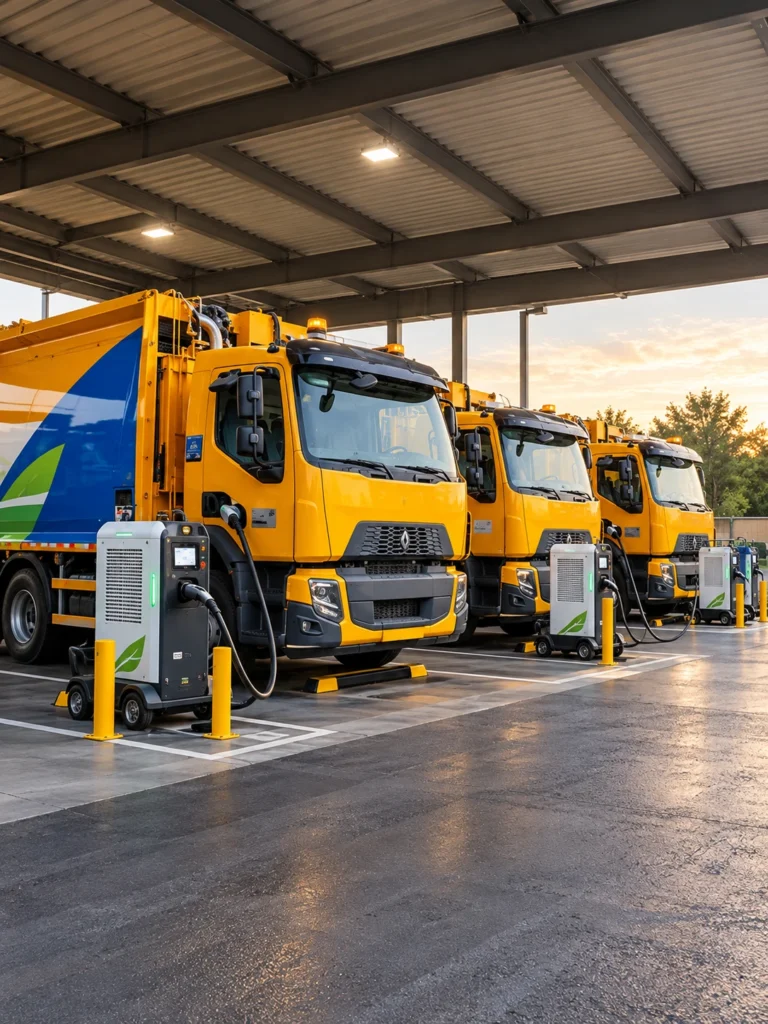
Level 3 DC fast EV charging fits most municipal duty cycles, because public sector vehicles work in shifts rather than sitting still all day. Level 2 charging delivers roughly 7 kW to 19 kW, which suits a unit parked overnight and fails a patrol car changing hands in 20 minutes. Bee Charged EV runs 4 tiers from 60 kW to 540 kW and matches the tier to each yard.
60 kW recovers one unit. An inspector ran low across the county, a patrol car came in short before shift change, a utility truck needs enough range to finish the call sheet. This tier returns usable range fast enough to save the rest of the shift.
150 kW fits the handover. Agencies running two or three shifts on the same vehicle have a short window between them, and that window is usually wasted. Charge inside it and one unit covers the whole day instead of sitting out the afternoon.
350 kW clears a yard. Motor pools and public works facilities release vehicles in waves at the start of the day, and this tier moves far more units per hour, so crews are not waiting on each other for power.
540 kW is our highest tier, built for agencies running dozens of electric units out of one facility, and for the heavy duty classes that need serious energy overnight. A single visit brings the whole group to service ready charge, which is the only realistic way to reset a large yard without a substation.
Charging slows past roughly 80 percent on every battery chemistry, so we charge to the level each assignment needs rather than to full. That moves more vehicles per hour and lowers what the agency pays per session.
Government & Municipal EV Fleet Types We Charge
Bee Charged EV charges every class of electric vehicle a public agency operates, from a pool sedan to a refuse truck, on the same booking and with the same connectors on board. Tell our dispatch team which classes sit in your yard and we size the visit around them.
Pool cars carry staff between offices, inspections, and meetings all day, and they are usually the first units an agency electrifies. We charge the Chevrolet Bolt, Nissan Leaf, Hyundai Ioniq 5, Kia EV6 and EV9, Tesla Model 3 and Model Y, Toyota bZ4X, and the Chevrolet Equinox EV and Blazer EV that now sit on state and cooperative contracts.
Electric pickups do the real work in a municipal fleet, hauling tools and crews across the jurisdiction with no predictable mileage. We charge the Ford F-150 Lightning, the Chevrolet Silverado EV, and the Rivian R1T, including units running upfitted beds, tool boxes, and power take off equipment.
Cargo vans carry parts, mail, meals, and equipment between facilities on fixed routes. We charge the Ford E-Transit, Ram ProMaster EV, Mercedes Benz eSprinter, and Brightdrop Zevo step vans working municipal delivery and service routes.
Patrol units draw power all shift from light bars, radios, laptops, and prisoner partitions, which pulls range down faster than mileage suggests. We charge the Ford Mustang Mach E, the Chevrolet Blazer EV police pursuit vehicle, and the Tesla Model Y units that departments across the country now run on patrol, at the precinct between shift changes.
Shuttles and paratransit vans run published schedules, so a low battery is a rider who misses a trip. We charge electric cutaway shuttles, accessible paratransit vans, and campus and facility shuttles at the yard between runs.
School buses are the largest electric fleet many districts will ever own, and bus yards rarely have charging for all of them on day one. We charge electric school buses from Blue Bird, Thomas Built, and IC Bus in the yard between the morning and afternoon routes, which is the window that decides whether the whole fleet runs.
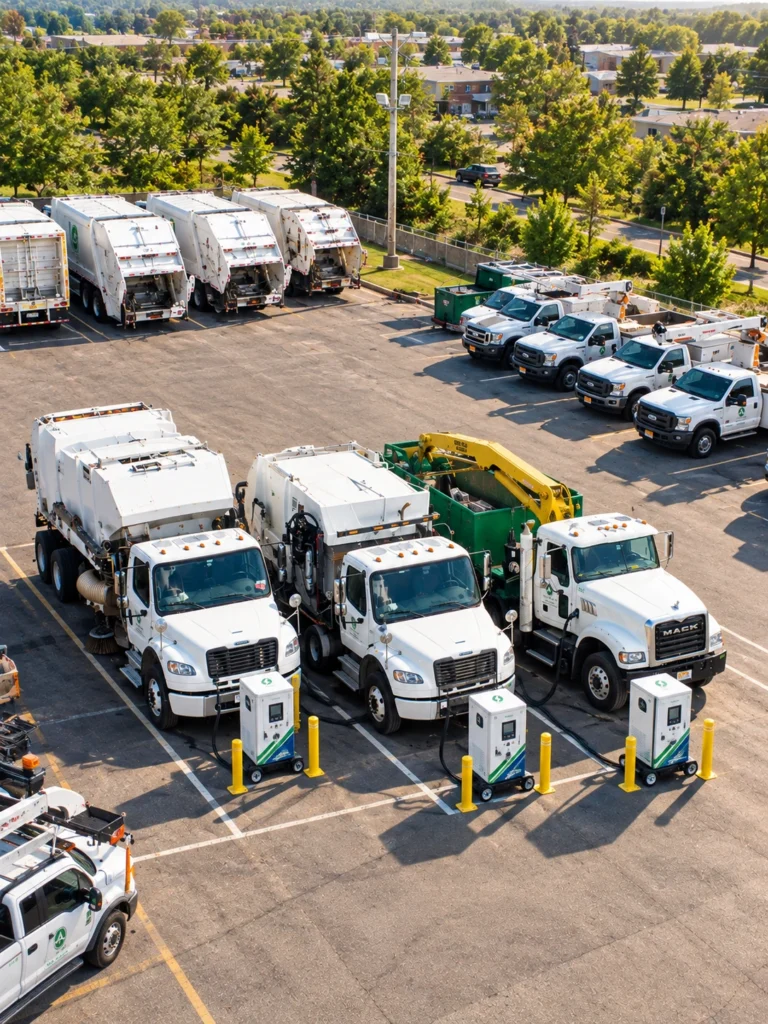
Refuse trucks run heavy, stop constantly, and work a route that cannot be shortened. We charge electric refuse units such as the Mack LR Electric, along with electric sweepers and specialty sanitation equipment, overnight at the operations yard on our highest power tiers.
Transit buses carry the biggest batteries in any public fleet and the least forgiving schedule. We charge battery electric transit buses, including New Flyer and Gillig units, at the division yard and at temporary staging during detours, construction, and service changes.
Most agency yards hold a little of everything: a few pool cars, several pickups, a van, and whatever heavy unit arrived with grant money. Our technicians carry every connector and work through the yard in one sequence, so a mixed class fleet is finished in one visit and billed on one invoice.
Government & Municipal Fleet Charging Locations
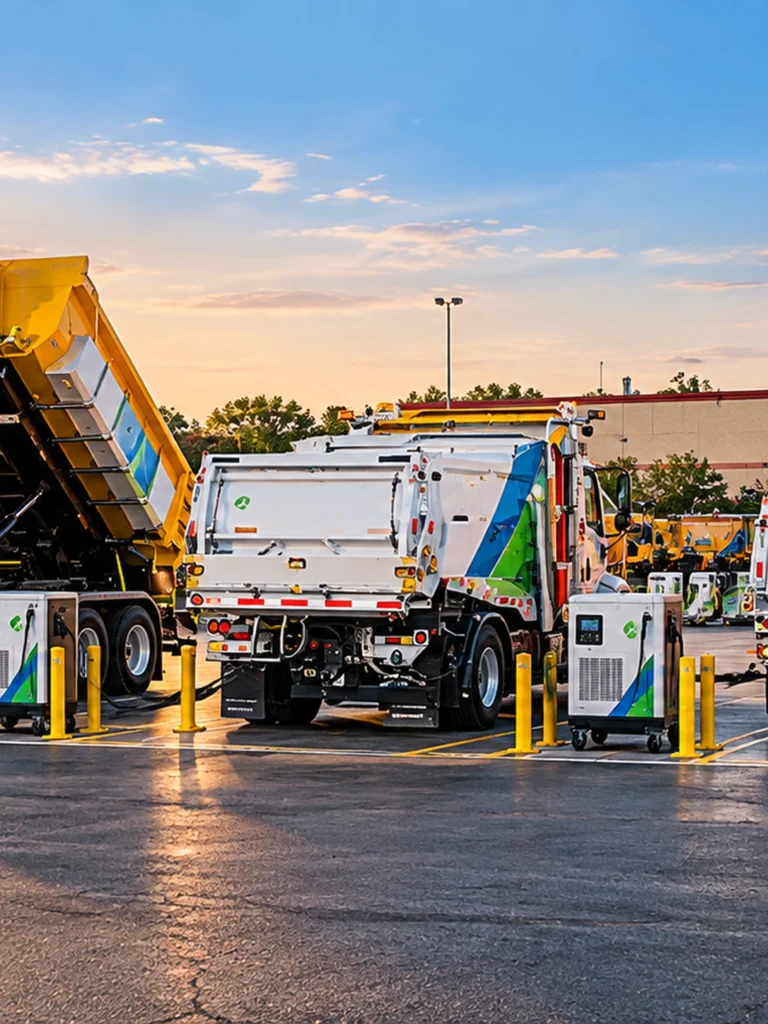
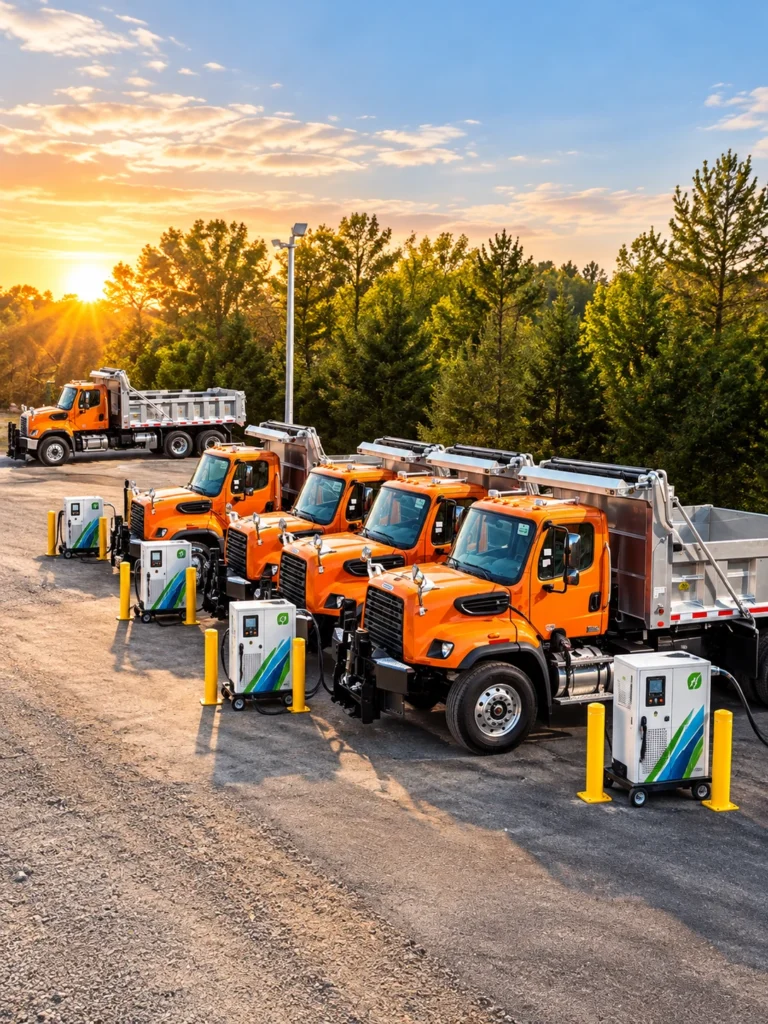
Public sector vehicles park in five kinds of place, and almost none of them have charging. We serve all five.
The central yard is the simplest job we do. Units are parked inside a secured facility overnight, crews are off duty, energy is at its cheapest hour, and our technician works through the lot so every vehicle is service ready at roll call.
Police precincts, fire stations, utility plants, airports, and port facilities all sit behind controlled access. Our technicians are background checked and badge eligible, so charging happens inside the fence line and units never leave their assigned district to find power.
Satellite sites are where electrification quietly fails, because no agency will fund chargers for 6 vehicles at a leased district office. A scheduled visit gives that site the readiness of the main yard, with nothing installed on property the agency does not own.
Road projects, inspections, storm operations, and seasonal work move every few weeks. Mobile EV charging follows the work, so a temporary staging area is no harder to serve than a permanent facility.
A crew stranded on an empty battery is a lost shift and a tow invoice. Our technician reaches the vehicle where it stopped and returns enough range for it to finish the day.
Government & Municipal EV Fleet Departments
Every department below runs electric vehicles on a public schedule, and each one loses service capacity the same way when a unit cannot roll.
Pool sedans, crossovers, and pickups carry staff between offices, sites, and meetings all day. These units are usually first to electrify and first to expose that the yard has no charging.
Electric pickups and work vans handle inspections, signage, repairs, and small hauling across the jurisdiction. Daily mileage is unpredictable, which makes a guaranteed morning state of charge worth more than a fast charger nobody can reach.
Patrol units run long shifts with idle time and onboard equipment drawing power. Charging at the precinct between shifts protects both response coverage and the shift schedule.
Command vehicles, fire inspectors, and emergency support units must be ready at all times, not charged when convenient. We schedule around station readiness rather than the other way round.
Water, sewer, electric, and stormwater crews respond to outages and breaks that do not wait. Charging on site keeps those trucks available for the next call instead of parked at a public station.
Inspectors cover long routes with many short stops, which drains range faster than mileage suggests. Overnight charging at the district office means a full day of appointments is never cut short.
Grounds crews, facilities maintenance, and recreation vehicles work from scattered sites with no infrastructure. Scheduled visits keep those units in service without building anything at each park.
Buses, supervisor vehicles, and paratransit vans support a system that runs on a published schedule. A unit that cannot roll is a rider who misses a trip, so readiness is service quality.
Districts run electric buses, maintenance trucks, and activity vehicles out of yards that were wired for diesel. Charging between the morning and afternoon routes is what keeps a grant funded bus fleet actually running.
Authority fleets operate on secured property where installing charging means capital approval, security review, and a construction window. Mobile charging needs only access and a schedule.
Caseworkers, nurses, and community program staff drive to appointments that cannot move. Charging at the office overnight protects a calendar that is already full.
Field offices, inspection units, and regional operations often sit far from any charging network, and their vendor requirements are stricter than a city's. We are built for both.
Government & Municipal Fleet Connector Coverage
Bee Charged EV brings all 3 connector standards on every visit, because a government fleet is bought across model years, contract vehicles, and departments.
CCS1 for most electric sedans, pickups, vans, SUVs, buses, and heavy duty units bought on state and cooperative purchasing contracts.
NACS for vehicles using the North American Charging Standard port.
J1772 for slower Level 2 charging overnight, where a unit sits in the yard for 10 hours anyway.
One visit finishes a mixed fleet. Your staff carry no adapters, and the agency settles one invoice.
Government & Municipal Fleet Charging Comparison
Agencies weigh 3 options, and the difference shows up in how soon the vehicles enter service.
| What decides it | Sending units to public charging | Building depot charging | Bee Charged EV mobile charging Mobile |
|---|---|---|---|
| Time until vehicles work | Immediately, but staff time goes with them | Months of design, permits, and utility work | ✓ Often the same week you call |
| Budget type | Operating, paid per session at retail rates | Capital, with a funding cycle attached | ✓ Operating, with no capital request |
| Procurement effort | Fuel card arrangements per driver | Design, bid, award, and construction management | ✓ A single service vendor onboarding |
| Staff hours | Crews drive and wait on the clock | Staff rotate units between stalls | ✓ None, our technician charges them in place |
| Heavy duty classes | Few public sites can take a bus or refuse truck | Needs dedicated high power stalls | ✓ Covered on our 350 kW and 540 kW tiers |
| Satellite and secured sites | Units leave the district for hours | Rarely funded for small sites | ✓ Served on the same schedule as the main yard |
| Yard electrical capacity | Not a factor | Usually needs a service upgrade | ✓ Not a factor, our units carry their own power |
| Reporting for grants | Scattered receipts per driver | Needs its own software and integration | ✓ Energy per vehicle and per department, included |
Most agencies end up running all 3. They build at the main yard where the volume justifies it, let crews use public charging in a pinch, and hand the daily, satellite, and heavy duty volume to Bee Charged EV, because that is the part that decides whether a unit rolls tomorrow.
On demand EV charging fits a government budget cycle because it is a service, not an asset. That single difference moves the decision out of capital planning and into the fleet's own operating line, where it can be approved in weeks rather than years.
Charging becomes an operating expense, so it stops competing with resurfacing, facilities, and apparatus for the same capital dollars.
Awards under programs such as the EPA Clean School Bus Program, the FHWA Charging and Fueling Infrastructure grants, NEVI formula funds, and state Volkswagen mitigation trust money all run on their own clock. Your vehicles earn service hours in the meantime.
Agencies engage us through a quote based award, a cooperative contract piggyback, or a sole source justification, and our team prepares the documentation each path needs.
Blanket purchase order with an annual not to exceed amount, option years, scheduled visit commitments, emergency response terms, and termination for convenience.
Energy reporting arrives per vehicle and per department, with your purchase order number and billing codes on the invoice, so charging is charged back to the cost center that used it.
Shared services work the same way. Two jurisdictions, a city and its county, or members of a regional council can run one agreement under an interlocal arrangement, with energy broken out per entity so each one pays only for its own vehicles.
Government Facility Security & Site Access
Bee Charged EV clears security before the first visit, because a government yard is not a parking lot. Access gets settled with your facility security team during onboarding, not negotiated at the gate at 2 a.m.
Our EV technicians are screened and badge eligible for restricted facilities, including police, fire, utility, airport, and port property.
We follow whatever your facility requires, from a sponsored badge to a standing escort arrangement for after hours work.
Certificates of insurance with the agency named as additional insured, supplied before work begins and renewed on schedule.
Cones, flagging, and clearances inside active yards, so charging never interferes with apparatus bays or equipment movement.
Technicians work from the charge port outside the vehicle, so units stay locked and secured throughout.
That is the difference between a vendor your purchasing office can approve and one your facility manager will not let through the gate.
Emergency Fleet Readiness & Disaster Response
Mobile EV charging keeps government fleets ready for emergencies because the unit generates its own power and travels to the operation. A storm response, an evacuation, or a multi day outage is exactly the moment a grid dependent charger is least useful and a self powered one matters most.
That holds across the situations agencies plan for:
A utility outage takes the yard's chargers offline while response vehicles still need range.
Crews stage at a temporary command post, an armory, or a fairground with no charging on site.
Mutual aid units arrive from another jurisdiction and need power they cannot find locally.
Storm and wildfire operations run continuously, so charging happens in rotation rather than overnight.
Shelter, debris, and recovery operations continue for weeks at sites that were never wired for a fleet.
Because the power arrives with us, the charging unit also becomes a resource at the staging site itself. Bee Charged EV operates 24 hours a day, so the schedule follows the incident rather than business hours.
Bee Charged EV is a federal government certified EV charging provider, which clears the vendor review agencies, authorities, and public institutions run before engaging a supplier.
Units already delivered start working now instead of after the charging build.
Restricted yards, precincts, stations, and airside facilities are routine for our crews.
Pool cars through refuse trucks, central yards through temporary staging, all on one schedule.
Energy per vehicle and per department, with cost allocation ready for each cost center.
Certified EV technicians handle every connection, so nobody on your payroll moves units or holds a cable.
Emergency operations, overnight yards, and pre dawn roll calls are all covered, in one jurisdiction or many.
Posted on Google
 Tedros Kefetew
Trustindex verifies that the original source of the review is Google.
Hats off to ‘Bee Charged Emergency Charge’ for the quick save on my electric vehicle – turned a potential breakdown into a minor pit stop. A must-have for any EV owner in need of a swift, dependable charge on the road!”Posted on Google Just NeneGood service , fixed it fast , and found the right tire for mePosted on Google
 Priscila AvinaGood service, kind and professional, I recommend totally. Antony is a good worker and he knows exactly what to do.Posted on Google
 Baltimore DetroitBest service and Quick I would highly recommend these technicians have great knowledgePosted on Google
 Helen CastilloQuick and helpful also very kind thank youPosted on Google
 Taylor SimmonsCan't thank BeeCharged EV enough! They were super quick to respond and had me back on the road fast. Definitely will recommend.Posted on Google
 Uni BizI was in a real pinch when my electric car's battery was running low, and I didn't have a charging station nearby. That's when I called Bee Charge, and they came through like champs! The team was super friendly and professional, showing up promptly to my location. They got my car juiced up efficiently, and I was back on the road in no time. Definitely recommend Bee Charge for any EV drivers in need of a fast, reliable mobile charging service. Two thumbs up from this satisfied customer!"Posted on Google
 XNickBig thanks to Bee Charge for the lifesaving assist – you guys always come through when it counts the most! Love you!Posted on Google
 Kylan“I recently used Bee Charge at an outdoor festival and was impressed by its speedy and efficient service. The charging station was user-friendly and surprisingly affordable, adding convenience to my day without any hassle. What stood out most was their eco-friendly approach, aligning perfectly with my values. Bee Charge is a reliable, eco-conscious solution for anyone needing a quick mobile charge on the go.”Posted on Google
 Jay Val: “Stranded in Temecula, Bee Charge quickly saved the day. Fast, reliable – a real EV lifesaver!”
On demand EV charging for government and municipal fleets is charging delivered to the vehicle instead of the vehicle being driven to a charger. Bee Charged EV sends a certified technician with a self powered Level 3 DC fast unit to your yard, precinct, station, or job site, and charges each unit to the level its next assignment needs.
Government fleets charge electric vehicles without building infrastructure by contracting the charging as a service. Our units generate their own power, so nothing is trenched, wired, or permitted on public property, and the yard's existing electrical service is never touched.
Agencies choose the service first because it reverses the order that strands vehicles. A permanent build has to clear design, bid, permits, and a utility interconnection before a single unit charges, while a service starts this week. Most agencies run the service while the build proceeds, then keep it for satellite sites the build will never cover.
Municipal fleets stay charged by using the hours a unit is already idle, which for most departments means overnight in the yard and the gap between shifts. Bee Charged EV schedules around roll call, so charging never competes with the hours crews are working.
Level 3 DC fast charging is best for most government fleets, because shift changes and emergency calls do not leave a full night of idle time. Level 2 still earns its place on overnight yards and long term storage, where a unit sits for 10 hours and speed buys nothing.
Yes, municipal fleets can cover their daily charging with mobile EV charging and skip installation entirely. That matters most at satellite yards, leased offices, and sites whose electrical service cannot carry a fleet without an upgrade nobody has funded.
Yes, our 350 kW and 540 kW tiers are built for heavy duty classes, including electric school buses, refuse trucks, transit buses, and specialty sanitation equipment. Bus yards and operations facilities are charged in sequence overnight, or between the morning and afternoon routes where that is the window that matters.
Yes, our EV technicians are background checked and badge eligible for restricted facilities, including police precincts, fire stations, utility plants, and airport and port property. Access, badging, and escort requirements are settled with your facility security during onboarding rather than at the gate.
Yes, agencies engage us through a quote based award, a cooperative contract piggyback, or a sole source justification, depending on how your purchasing office prefers to work. Bee Charged EV is a federal government certified EV charging provider, and we prepare the documentation each path requires, including vendor registration, a W9, and insurance certificates naming the agency as additional insured.
Yes, and that is one of the most common reasons agencies call us. Grant awards and construction schedules run on their own timeline, so mobile charging bridges the gap and the vehicles you already own earn service hours instead of sitting in the yard.
A municipal fleet can schedule recurring charging at any hour, because we operate 24 hours a day. Most agencies lock a fixed overnight window at the central yard, then add daytime visits for precincts, stations, bus yards, and satellite sites.
No, there is no minimum. We charge a single unit stranded in the field and we charge yards holding dozens. Small departments often feel the gain fastest, because one vehicle out of 6 off the road is a sixth of that department's capacity.
Yes, multi site agencies run on one agreement, one schedule, and one invoice, with energy broken out by site, department, and vehicle. Two jurisdictions, a city and its county, or members of a regional council can share that agreement under an interlocal arrangement, with each entity billed only for its own units.
Yes, emergency charging is available for any unit that runs out on assignment. Give us the location and the model, and a technician reaches the vehicle where it stopped and returns enough range to finish the shift, with no tow and no lost day.
Yes, our units bring their own generation, which makes them useful at a command post or staging area where the grid is down or absent, and we support bidirectional charging arrangements. Tell our dispatch team what the incident plan requires and we confirm the configuration for your vehicles before deployment.
Yes, upfits change the math more than most fleets expect. Light bars, radios, laptops, lift gates, aerial equipment, and power take off all draw from the same battery, so a patrol car or utility truck returns with less range than its mileage suggests. We set the target state of charge against the real duty cycle rather than the window sticker.
Yes, cold weather cuts usable range and slows the rate a battery accepts power, which is why northern agencies feel the pinch during snow and storm operations. We raise target charge levels and add visits through the winter months, so a unit that comfortably covered a route in June still covers it in January.
Four moves carry most of the saving. Charge overnight while units are idle so charging never costs crew hours. Charge to the level the assignment needs rather than to full, since the last portion of a battery is the slowest to fill. Cover satellite sites on a scheduled visit instead of paying staff to drive units across town. And track energy per vehicle, so a weak battery or a badly planned route is caught before it costs a service day.
Yes, every session reports kWh delivered, start and finish charge, time, site, and cost per vehicle. Agencies use that for grant compliance, climate action plan updates, cost allocation between departments, and spotting a unit whose energy draw has climbed.
Yes, session data is delivered in formats your team can load into a fleet management information system or reconcile against telematics, so charging sits beside fuel and maintenance history rather than in a separate silo. Tell us which system you run and we match the export to it.
No, nobody on your payroll moves a unit or touches a connector. Certified Bee Charged EV technicians handle every connection and disconnection inside the yard, which also keeps the work clear of staffing and work rule questions.
A city pilots us by putting one yard or one department on a scheduled window for a few weeks. You measure service days recovered, staff hours saved, and energy cost per vehicle against what that site was spending before, and the reporting from the pilot is what supports the wider decision.
Call us and put those units on a charging schedule this week. Vehicles delivered ahead of infrastructure are the exact situation this service exists for, and they can enter service immediately while the permanent build continues on its own timeline.
Bee Charged EV serves public sector fleets nationwide, including California, Nevada, Arizona, Colorado, Texas, Florida, Georgia, North Carolina, South Carolina, Tennessee, Kentucky, Illinois, Michigan, Minnesota, Ohio, New York, New Jersey, Pennsylvania, Massachusetts, Maryland, Virginia, Washington, and Washington DC. Call us to confirm coverage for a specific yard or facility.
An electric vehicle parked in the yard serves nobody. Bee Charged EV brings Level 3 DC fast charging from 60 kW to 540 kW to your yards, precincts, stations, bus facilities, and job sites, with background checked EV technicians, reporting per vehicle and per department, and coverage around the clock, nationwide.
Call 18886759555 and tell us how many units are waiting on a charger.